Thursday, 29 November 2018

Post Office - Charles Bukowski

POST OFFICE – CHARLES BUKOWSKI

When I first read Post Office by Charles Bukowski as a teenager I didn't really rate it. Reading it again years later, however, I appreciate it much more and am duly impressed. Why might this be? Age and experience, I presume? As a teenager I would have had little concept of the world of work apart from the fact that I didn't wish to get too heavily involved in it. Having now worked at a variety of jobs of the kind that Bukowski writes about in Post Office, I can now understand where he's coming from. In addition, now that I know a bit more about Bukowski and thanks to YouTube have now heard his beautiful voice, I appreciate him much more as a writer.


Post Office is a book that probably everyone should read, particularly those stuck in low-paid, menial, exploitative jobs. And believe me, that's a lot of people. Bukowski nails it again and again by highlighting all the small but universal things that come with having a crap job. The low pay (of course), the impossible hours, the petty rules, the strict productivity, the impossibility of saving anything from the low wages, the overtime to make ends meet, the mealy-minded managers, the constant tiredness, the resultant ill health, the high turnover of staff, the cretinous work colleagues, the constant fear and threat of dismissal, the repetitiveness, the stupidity, etc, etc.

That's not to say it's all doom and gloom because when you're working in a low-paid, menial job there is always a dark humour to it. For those who have a sense of the ridiculous there is never ending laughter to be had either at your own expense or the expense of those in job positions above that of your own.
And so it is with Bukowski's Post Office. There is a sense of humour that pervades the whole book be it when he's writing about his job or when he's relaying comic tales from his social life. Alongside this there is also madness, sadness, celebration and hope. All the stuff of life, essentially.

Bukowski weathers the storm and at the end makes his move to a better life by resigning from his job after enduring it for twelve long years. Not to move into better employment but to move away from employment altogether for the sake of his health, his sanity, his soul – and for the hell of it.
'Maybe I'll write a novel,' Bukowski thinks to himself. And so he did, and he called it Post Office.

There's a quote by Charles Bukowski where he says: 'How in the hell could a man enjoy being awakened at 8.30am by an alarm clock, leap out of bed, dress, force-feed, shit, piss, brush teeth and hair, and fight traffic to get to a place where essentially you made lots of money for somebody else and were asked to be grateful for the opportunity to do so?'

Is this not a universal truth? There are jobs that can be enjoyed, of course, and there is such a thing as the dignity of labour but when you're talking about low-paid, menial, exploitative jobs this all goes out the window. The tragedy of it is that a huge swath of people have no other option but to work in such jobs if they wish to survive in the world. You work or you starve. You work or you lose your home. You work or you die. Or so we're led to believe. The even greater tragedy of it is that still to this day nothing is very different to how it's always been and in many ways is actually even worse now.


It's just the way it is, you might say? And you wouldn't be wrong. But does that mean it's just the way it's always going to be? Does that mean it must only get worse, with all those stuck in the drudgery of rubbish jobs being ground down ever further year after year, generation after generation?
There must be some kind of way out of the poverty trap, surely? And there is. For the individual – on their own – there are indeed ways to strike out for a better life. In Post Office, Bukowski writes his way out using the subject of his job at the post office as source material, along with tales of his life in the gutter as he looks up at the stars. And that's fine. That's all well and good. But rather than individuals escaping one at a time, what is really required is for there to be a mass breakout, for everyone to escape en masse and for there to be no-one left behind. For until all are free, none are free.
That is the dream...
John Serpico

Thursday, 22 November 2018

Under Exmouth skies (Part 46)

UNDER EXMOUTH SKIES (Part 46)

It seems like only last week when it was summer and I would at the end of a day sit and watch swallows fly into the setting sun...

Friday, 16 November 2018

Twisting My Melon - Shaun Ryder

TWISTING MY MELON – SHAUN RYDER

I'm sorry but when I look at the cover of Shaun Ryder's Twisting My Melon autobiography all I see is a nose. It's a very weird nose he's got, don't you think? Like a proboscis monkey. I wonder if the vote on whether or not to use this particular photo for the cover was unanimous? I mean, if you're going to have a photo of Shaun on the cover of his autobiography then surely it should be the one of him inside a letter 'E', as featured once on the cover of the NME? The publishers obviously had the same thought but they've opted instead to use just a part of that photo for the back cover. I wonder why?
And if you can manage to tear your gaze away from Shaun's nose for a moment, what is that look he's giving? Is that his 'come to bed' eyes? His 'come hither' look? Thanks, Shaun, but I think I'll sleep on the couch tonight if you don't mind?


There's something incongruous about the cover as well, as in the banner headline at the top declaring 'The Sunday Times bestseller'. Maybe it's me but my perception of the Sunday Times and my perception of Shaun Ryder are at complete odds with one and other. I don't understand at what point the two worlds meet. I just can't imagine Shaun telling us how much he appreciates the Sunday Times aesthetic when it comes to art and their approach to it, and how his weekend isn't complete without digesting the thoughts and political insights of their columnists. Just as I can't imagine the Sunday Times writers applauding and pontificating over the merits of petty theft, drug taking and tales of growing up on a shitty council estate in Salford. All over a few glasses of Pinot Noir and some little saucers of nibbles.

There's a clue, however, in the quote from the Sunday Times displayed prominently on the cover where it says 'Fantastically entertaining... a seamless, authentic, exhilarating read'. It's that word 'authentic'. It's a very middle class word, I think. It's the kind of word used by middle class writers when they describe something or someone they like but would never choose to inhabit the place where that same something or someone is coming from. It's a word used to recuperate something (or someone). And it begs the question: Is the Sunday Times advocacy and promotion of Shaun Ryder's autobiography a way of recuperating an aspect of working class culture?

Am I making too much of this, I wonder? Well, possibly not because Shaun even touches upon it himself when talking about the Wrote For Luck video: 'The Manchester Evening News would never really touch us as a band, before we made it, and part of that was because we were the sort of people that they would cross the street to avoid if they were coming out of a pub late at night in the centre of town. A lot of people in the media were a little bit frightened of what was happening at that time, because they just didn't get it'.
Not that Shaun could care less about such a thing so long as he was being paid top dollar for it. More fool the media, if anything.

'Come hither...'

As almost to be expected, Shaun's story steps up a gear when the E starts making an appearance in the summer of '87. Up until that point Happy Mondays were just another Northern Indy band struggling to establish themselves in the wake of Joy Division and New Order. Rather cruelly but succinctly, Julian Cope summed up the Mondays at that time (dressed up in their anoraks and cagoules) when he said of them: 'Who do they think they are, the fucking Undertones?'. An observation the Mondays didn't take very kindly to.
The E, of course, changed everything and being right in the middle of it, Shaun's take on the whole subject is a valid one: 'I knew idiots who would go out and fight and stab people, people whose whole night was about going out and kicking off in a bar and having a fight, or going to the match and kicking off. That's what it was all about for them, but once they started taking the E, that fucking shit stopped. It's a cliché, but it's absolutely true. You could see everyone really loved up, and yet at the same time you're reading in the press about this killer drug being the downfall of society. It was complete bullshit and it just makes you wonder about what other bullshit they are feeding you'.

It must be said, there was no great meaning to the Happy Mondays. No insights, no pertinent message, just hedonism essentially. The Happy Mondays were a vibe, a groove, an attitude, a nod and a wink. Represented perfectly by Bez, a man whose sole contribution at first sight seemed only to dance on stage with them whilst shaking some maracas but in actual fact was the key to the band. The Happy Mondays could have been a silent disco. In fact, if you watch a Happy Mondays video (such as the one for Wrote For Luck) with the sound off you get just as good an idea of what they're about as you would by watching the video with the sound on.
And no matter what Tony Wilson said about Shaun's lyrics on a good day being are on a par with WB Yeats on an average day, though he possessed a distinctive voice he was no great lyricist. Never did he come out with anything on a par with (for example) Higher Than The Sun by that other great 'E' band, Primal Scream. Or even anything by The Shamen, come to that. Shaun's lyrics were psychobabble. Words strung together simply because they sounded good. And Shaun's happy to admit it, so it's not a criticism at all.

I saw the Happy Mondays that time when they played Glastonbury, when it was the mud bath and they'd snuck a photocopier in so they could duplicate back-stage passes for their entourage. They were a suitable shambles but then if they had been slick and professional they wouldn't have been living up to expectations. The funniest thing about them, actually, was their fans in their flares. It was the most unsuitable trousers for such conditions as you could get. Caked in mud, their flares must have weighed a tonne as they dragged themselves around the site. Suffering for fashion, I guess, but as Joe Strummer once said, 'like trousers like brain'.

Twisting My Melon is over 400 pages long so it isn't just a quick read. It would obviously be beneficial when reading it to be a Happy Mondays fan but if you're not, it's a bit of a challenge. For all that, it's an entertaining romp if scamming, crack cocaine and an unspoken fear of the working class is your bag. Which might explain why the Sunday Times like it so much...
John Serpico

Tuesday, 6 November 2018

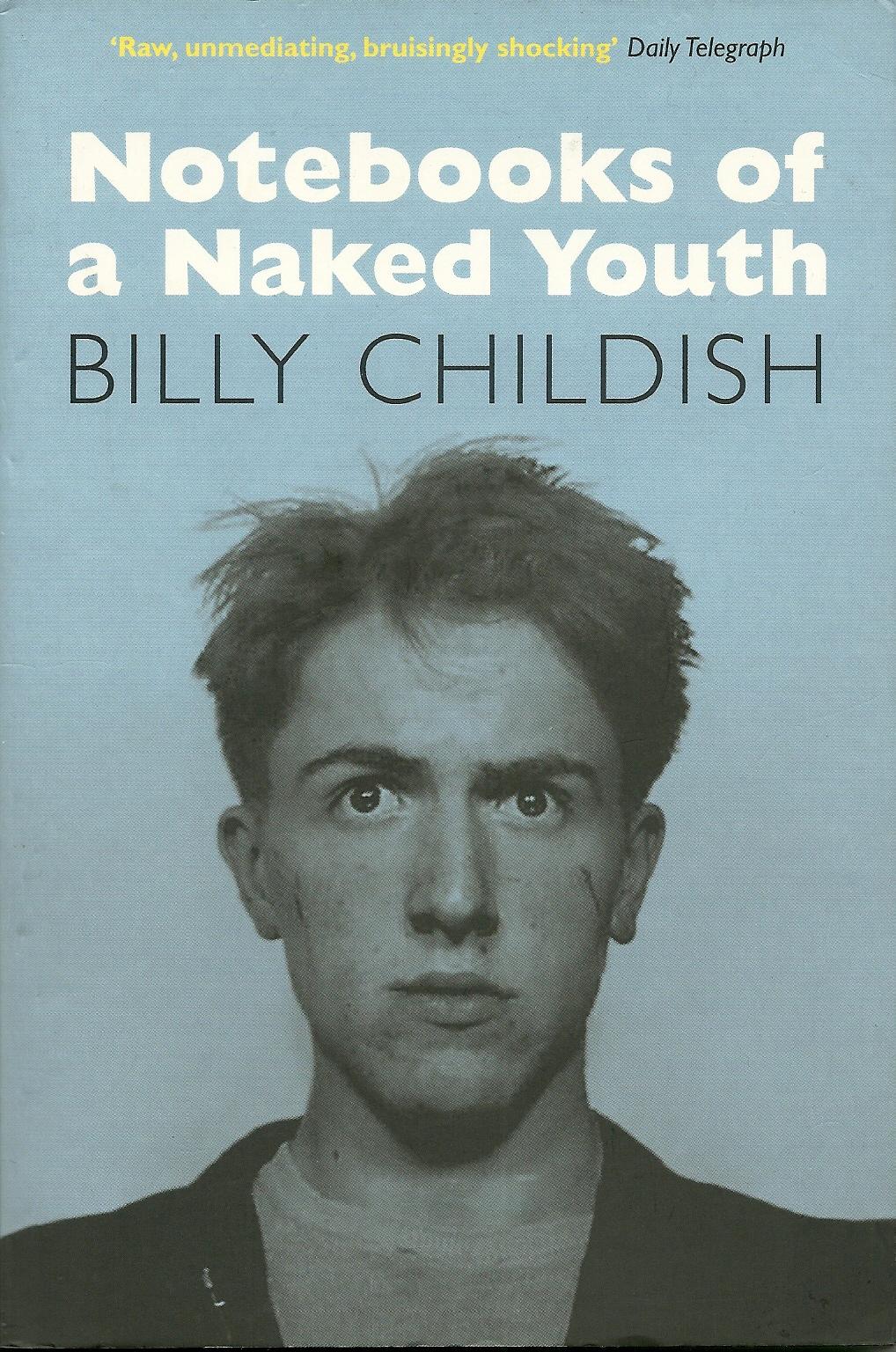
Notebooks of a Naked Youth - Billy Childish

NOTEBOOKS OF A NAKED YOUTH –
BILLY CHILDISH

I admire and respect Billy Childish – the man, his music, his art and his moustache. He also still gets my vote for being the Greatest Living Englishman. Unfortunately, there's something about Notebooks of a Naked Youth - his sequel to his début novel, My Fault - that makes it inferior to it's predecessor rather than being it's equal or even its better.
There's a sense about it of being a work in progress, as if there was no clear aim as to where the book was going to go or of even what kind of book it was going to be. It starts off as if this time Childish is playing it for laughs and effecting a style of writing that displays his somewhat dark and twisted sense of humour. It ends up as a sort of bastard child of William Burroughs and Henry Miller.


The narrator's voice is that of an imbecilic child inside the body of a young adult, or of someone with Aspergers who doesn't know how to properly relate with other people. It's rather like the Paddy Considine character in the Shane Meadow's film A Room For Romeo Brass. Is it an affected voice, I wonder? A fictional voice utilised to relay the story? Or is it Billy Childish's actual voice? I don't want to give offence but it's hard to tell. Either way, though it's a disturbing voice it's noticeable that it's not such an intense voice as that heard in My Fault.

Between the comical narration there are indeed plenty of disturbing episodes such as when the author is stalking a 15 year-old girl, or when he's stopped by the police and they see he's wearing a trick toy ring water pistol – and they ask him if it contains drugs? Or when he's about to have sex with 'the Jewish lady' and he suddenly remembers lying in bed with 'uncle' Norman who's tugging his trunks down round his knees and whispering 'Can you keep a secret?' Or when he's on a bus and he accuses all the other passengers of having 'mind mirrors': “You think that I don't know that you've all got mind mirrors?” he shouts “You think that I don't know that you can look into my darkest thoughts? You think that I'm mad, that I'm sitting on this bus amongst you strangers and that I don't know that you all have mind mirrors! Go on, cross your gangrenous legs and hold your newspapers to your noses like I'm invisible, all the while secretly studying me with your hideous, disrespectful, hypocritical mind mirrors! Ignore me then, damn you! But don't think for one minute that I don't know all your names and addresses, you scallywags!” We've all met this person before, haven't we? On the Underground, at the shopping centre, or even on the bus? The person we try to ignore and keep away from in case he turns his attention explicitly upon us?
Billy Childish is that person.

What is even more disturbing about the book, however, is the blurring of the lines between fantasy and reality, and between fiction and fact. Did Childish really fuck a dog? Has he really killed a little girl and her tiny, bird-like body now lies hidden in his blue cardboard guitar case? Who knows? It's feasible. Is this a work of fiction or a memoir? The edges are so blurred that it's hard to tell.

Billy Childish is an extremely interesting character which makes for anything he creates being equally interesting; be it art, music, poetry or prose. For all its faults, Notebooks of a Naked Youth easily falls into that same canon.
                                                                                                                                        John Serpico

Tuesday, 23 October 2018

The Vagabond's Breakfast - Richard Gwyn

THE VAGABOND'S BREAKFAST –
RICHARD GWYN

Richard Gwyn? No, I've never heard of him either. But just because we don't know the name of an author doesn't mean we should ignore him because if we did that all the time we'd still only be reading, for example, Jeffery Archer. Which raises an obvious question: What is it that attracts us to certain books? Mostly it's what's on the spine, of course, because that's all we initially see when on a shelf. So it's going to be the author's name, the title, the design, the publisher, the colour, or even the hype and a good publicity campaign. Not to mention what Jung termed 'synchronicity' – but that's a whole other story.
On pulling out the book we initially look at the front cover, then the back cover for the blurb, then we open up the book and choose a page at random (never the end) and read a snatch of it. On these things we make a decision as to whether we buy the book but more importantly, whether we are going to devote our time and attention to it. Whether we are going to give a portion of our lives to it.


And so to The Vagabond's Breakfast by Richard Gwyn. I presume it was the title that first caught my attention because I didn't know what it meant? Or perhaps it was synchronicity? The cover at a glance was nondescript and gave away no clues. The blurb on the back on scanning it said something about 'vagrancy and alcoholism in the Mediterranean, principally Spain and Crete'. On opening a page at random I fell upon the author expounding upon the imbibing of datura on Crete.
I bought the book.

Richard Gwyn is the Director of the MA in the Teaching and Practice of Creative Writing at Cardiff University, or at least he was when this book was published in 2011. Before this, however, he had spent 10 years as an itinerant worker/vagabond alcoholic in countries around the Mediterranean, some of those years being on the island of Crete.
Gwyn cleverly weaves his memoir between tales and anecdotes from those times and his present day situation where he is suffering from insomnia whilst waiting for a liver transplant due to contracting hepatitis C; all interlaced with thoughts and meditations on various subjects dear to him. It all makes for a surprisingly good and very beautifully written book.

As a teenager I also lived in Greece for a few years living the life of a traveller and for a couple of those years I too lived on Crete where I worked on building sites and farms and in saw mills and factories. I lived in pension houses, proper rented houses, in community shared houses and for long periods of time in no house at all, choosing instead to sleep on beaches, in woods and on mountains. I was a beach bum, a mountain boy, a Cretan cowboy. This, coincidentally, was at the same time as when Richard Gwyn was there.

Did I meet him? I'm not sure. We were certainly moving in the same circles and crossing paths with the same kind of people. I met so many different characters during that period that it's hard to recall all of them after all these years although the name of one of the people Gwyn talks about – a German called Hubert – certainly rings a bell.


In his book, Gwyn describes the kafenions populated by 'carousing travellers, the post-punk detritus of northern Europe and stoned hippies who had got lost on their way back from India'. I too have met these people in similar eateries. He describes hauling bags of cement up flights of stairs when labouring on so-called Cretan construction sites. He describes working in the giant green houses, picking tomatoes, cucumbers and bananas in the suffocating heat. These things I too have done.
He writes about the Romany gypsies of Crete who I too have travelled with, romantically viewing them at the time as being like gold-toothed Apache indian warriors. He writes about the kamakia of Crete, the local boys who were basically studs servicing the tourist women on holiday from Germany and Sweden. I had been wearing a Crass badge at the time – the anarchist symbol with the snapped sub-machine gun above it – and the local kamakia befriended me because of that badge. They knew nothing about Crass but they knew what anarchy was.
And he writes about datura, otherwise known as jimson weed, a wild-growing plant found in Greece that just also happens to be a very powerful hallucinogen.

Gwyn describes his experience of imbibing the seeds of the datura plant in a very open and honest manner, neither deluding himself about nor denying what occurred during his trip and neither exulting or downplaying the experience. He admits that at the time he knew very little about datura apart from the reading of Carlos Castaneda books, this being very understandable. There was no Internet back then so these kind of things were very hard to reference. Nowadays you can look up 'datura' on Wikipedia and even view footage on YouTube of Terence McKenna advising to be very wary of the plant. Back then, however, you just took the big plunge, as Patti Smith once put it.

'In terms of hallucinogenic experience,' Gwyn writes 'datura is a world apart from LSD or mescaline: recreational it is not. It will, if such language has any meaning, attempt to infiltrate the soul. Specifically, I was made acutely aware of the existence, parallel to our own visible world, of a wondrous and terrifying otherworld in which we were unwitting participants. That this otherworld was as real as the one we normally inhabit was never in doubt while under the influence of the datura plant. I still retain the vivid impression that for one night and part of the following day the veil between these worlds had been removed.'

During my time on Crete I too imbibed datura seeds but unlike Gwyn I'd never read Carlos Castaneda so knew even less about the plant than what he did. Little did I know that it was a plant that such people as Nepalese shamen and holy men specialised in taking.
Years later, I recall very little of the experience apart from a distinct feeling of levitating 15 feet in the air and seemingly seeing, sharing and experiencing other people's dreams and hallucinations. The sense of the 'otherworld' was also palpable, where every word spoken was loaded to the max and every gesture, every touch, every glance was unspoken communication conveying volumes. No Howard Marks was I but I do recall coming back to the UK with a tobacco tin full of datura seeds to distribute to interested parties though I never took them myself again. Without any doubt, datura is the most strangest drug I've ever taken and it would appear that Richard Gwyn might feel the same.

The datura episode Gwyn writes about, however, is but one very short chapter and in no way is The Vagabond's Breakfast solely a drug book. In fact, I wouldn't even say alcohol is a major theme in the book either. Richard Gwyn's memoir is instead a story about the getting of wisdom. It's the story of the author losing himself so as to be able to find himself. Above all, I would say it's a very inspiring example of how to write a very good book indeed.
John Serpico

Tuesday, 16 October 2018

Noam Chomsky - Keeping The Rabble In Line

KEEPING THE RABBLE IN LINE –
NOAM CHOMSKY

By denouncing their practises, methods and tactics, Noam Chomsky may have blotted his copy book with some of our black-clad brethren in Antifa but does that mean in return his whole canon should now be dismissed? Of course not. Chomsky's now in his nineties and though he may still be as sharp as a needle when compared to most, at his age we can forgive him for a few lapses in judgement because after all – he's earned it. So yes, Chomsky's still worth reading if only for food for thought and that's something he's always been a good provider of.


Keeping The Rabble In Line is another one of those books published by AK Press composed of interviews with Chomsky by writer and broadcaster David Barsamian. The first thing to consider about it is the title. Who exactly is the rabble and why is it important to keep them in line? Well, the rabble is me and you, basically. It's the general population, the general public, or as writer and political commentator Walter Lippmann put it, the “ignorant and meddlesome outsiders”.
According to Chomsky, any holders of concentrated power, and that includes corporations of course, do not want any external constraints on their capacity to make decisions and act freely, so to these ends they want the general public to be mere spectators, not participants. Democracy acts simply as a way of legitimizing the power held by those whom it benefits most, which means in elections it's typically representatives of dominant sectors who stand and their actions on being elected serve only to maintain the status quo.

Democracy and casting a vote every few years maintains the illusion that concentrated power and authority can be controlled through the ballot box but as the old anarchist maxim says: 'Whoever you vote for, government wins' – and it's true. It's a very simple truth.
That's not to say liberal democracy and voting is entirely ineffectual because it does at least give the general population the opportunity to choose their prison guards and that in itself counts for something. At the end of the day, however, they're still prison guards. What would you rather have: A racist, sexist, bullying leader or representative who hates you (in either business or government) or a benign leader who is anti-racist, anti-sexist who tells you they love and care for you? It's the good cop bad cop scenario but at the end of the day they're still both cops.

As Chomsky explains, it's possible that there could one day be a colour-free society and that the glass ceiling for women is removed but this wouldn't actually change the political economy at all. For this reason you often find the business sector quite happy to support efforts to overcome racism and sexism because they know that these things don't matter much. Some white male privilege might be lost but that's not all that important in the scheme of things. On the other hand, basic changes in the core institutions would be bitterly resisted, that's if they ever even became thinkable.


So if the general public is the rabble, then who are the holders of concentrated power? Well, though they're definable it's no easy task as their faces and names keep changing. Chomsky refers to them as the 'ruling elite' though that term's been criticised for conferring too much dignity upon them. Interestingly, he shies away from using the word 'class' as in 'ruling class' due to its various associations. As he explains: 'As soon as you say the word 'class', everybody falls down dead. There's some Marxist raving again.' Or nowadays some Right-wing zealot raving.
Alternatively, Chomsky suggests they can be referred to as 'the masters' who in the words of economist and philosopher Adam Smith follow their own 'vile maxim', namely 'all for ourselves and nothing for other people.' Or at best, crumbs from the table for other people, I would say. Again, it's a very simple truth.

At one point in Keeping The Rabble In Line, Chomsky discusses Ghandi and questions whether non-violence should be an absolute principle? Apparently in 1938 Ghandi suggested that German Jews ought to commit collective suicide so as to arouse the world and the German people to Hitler's violence. Chomsky emphasises that what Ghandi was suggesting was a tactical proposal, not a principled one but at the same time finds it somewhat grotesque. What Ghandi should have been emphasizing, Chomsky says, is for the world to do something to prevent the Jews from being massacred:
'Powerless people who are being led to slaughter can't do anything. Therefore it's up to others to do something for them. To give them advice on how they should be slaughtered is not very uplifting, to put it mildly. You can say the same about other things all the time.'
And indeed you can. Just name your poison. But before you go chasing rabbits and liaising with hookah-smoking caterpillars, just make sure you're not going off on some crazy wild goose chase which is going to involve you in extremely detailed microanalysis and discussions of things that don't matter. Conspiracy theories, in other words.
'If it's too hard to deal with real problems, there are a lot of ways to avoid doing so. One of them is to go off on wild goose chases that don't matter. Another is to get involved in academic cults that are very divorced from any reality and that provide a defense against dealing with the world as it actually is.' And this, of course, can mean anything from the assassination of JFK, the destruction of the Twin Towers on 9/11, to the question of how modern day linguistics provide a new paradigm for discourse about international affairs that will supplant the post-structuralist text.... For example.

In amongst such food for thought as provided by Chomsky you're going to find the odd fly in the soup and the odd bite that's unappetizing (such as when he states that 'Europe is an extremely racist place' compared to America) but that's only to be expected. Overall, Keeping The Rabble In Line is a good, four-square meal and Noam Chomsky is a very, very good cook and at the end of the day, dining out with him makes a pleasant and nourishing change from McDonalds. And again, that's a very simple truth.
John Serpico

Friday, 21 September 2018

Fahrenheit 451 - Ray Bradbury

FAHRENHEIT 451 – RAY BRADBURY

Oh that Tower of Babel they knew what they were after. They knew what they were after.
Patti Smith – Land.

When in 1953 Ray Bradbury wrote Fahrenheit 451, little could he have known at the time but he was touching upon something of much significance. Alongside the other great future dystopia novels like Brave New World and 1984, Fahrenheit 451 unexpectedly now stands as being the most accurate vision of how the world might one day be. What Bradbury was doing was presenting a future vision that today is actually very recognisable. You can ignore the whole aspect of it regarding firemen going out and setting fire to houses found to be containing books because essentially that's just a plot device to carry forward the main idea. No, the real story is in his depiction of a society where wall-to-wall entertainment is constantly at hand so as there to be no need to think about anything else.

There's a telling paragraph half-way into Fahrenheit 451 where the fireman, Montag, rants at his wife about the jet bombers crossing the sky over his house: '”Jesus God,” says Montag “Every hour so many damn things in the sky! How in hell did those bombers get up there every single second of our lives! Why doesn't someone want to talk about it? We've started and won two atomic wars since 1960. Is it because we're having so much fun at home we've forgotten the world? Is it because we're so rich and the rest of the world's so poor and we just don't care if they are? I've heard rumours: the world is starving, but we're well fed. Is it true, the world works hard and we play? Is that why we're hated so much?”'
This one paragraph in itself can easily be translated to today's world where there is never-ending war in the Middle East, unimpressive narcissists in governments everywhere constantly on the verge of setting off World War Three, constant economic doom and gloom, and massive inequality both locally and globally with nobody ever asking 'Why?' or 'How did this all come about?'


Instead, we are all kept constantly distracted by any and all kinds of entertainment be it sport, television, the Internet, music, etc, etc. Everything to a degree is entertainment, of course – even books, but when the news is also being presented as entertainment – even tragic news – then something is clearly not right. It's all one big show keeping us all equally occupied and equally happy it would seem. Everybody's happy nowadays, to quote Huxley from Brave New World but to paraphrase Orwell's Animal Farm: We are all happy but some are more happier than others.

In Bradbury's book the entertainment is represented by a sort of inter-active television system that 'talks' to the individual viewer. Giant plasma screens are built into the wall of the home (or all four walls if it can be afforded) which show a constant stream of soap operas, game shows and advertisements. Even when asleep, a 'shell' can be inserted into the ear to keep up the same constant stream.
Essentially, Bradbury appears to be predicting the advent of the Internet but at the same time he highlights the fact that none of it is imposed from above as a form of oppression but sanctioned, endorsed and lapped up from below.
Anything that might potentially counter the entertainment and subsequently jeopardise people's happiness – such as books, for example – is made less and less welcome until it's eventually banned. Bradbury's firemen are simply the guardians of society's happiness and therefore burn books for they contain nothing but the destructive seeds of unhappiness.

Montag, the main protagonist, however, starts to have doubts. There's something in the way the world is that isn't right, he feels. Why do people never talk about anything of interest, he wonders? Why doesn't anyone listen anymore? Why would someone choose to burn themselves to death alongside the burning of their books? Surely, there must be more to life than thisBut for Montag there is nowhere to go to for answers apart from, perhaps, the very things he has spent his whole adult life destroying: Books.

'”It's not books you need,” an old English professor advises him, however “It's some of the things that once were in books. The same infinite detail and awareness could be projected through the radios and televisors, but are not. No, no, it's not books at all you're looking for! Take it where you can find it, in old phonograph records, old motion pictures, and in old friends; look for it in nature and look for it in yourself. Books were only one type of receptacle where we stored a lot of things we were afraid we might forget. There is nothing magical in them at all. The magic is only in what books say, how they stitched the patches of the universe together into one garment for us.”'

And that's the nub: Why do some people still desire and look for that magic while so many others don't? Why do some people choose to read books in a quest for that magic while so many others choose not to look for it anywhere at all? Why do some people take the time to read a book while so many others just want the summary or the soundbite? Are books actually still of any value in today's world or are there other things, other receptacles that have taken their place? If so, are these other receptacles of the same quality? Do they still convey the magic? Are books still worth the effort? Are people bored with books? Are people bored of reading? More pertinently, why are people more than happy to scroll past hundreds of Facebook posts but can't be bothered to read a longer post on a blog?


There's a scene in Mike Leigh's film, Naked, where the anti-hero, Johnny, rants at his girlfriend: “Was I bored?” he asks her “No, I wasn't fuckin' bored. I'm never bored. That's the trouble with everybody - you're all so bored. You've had nature explained to you, and you're bored with it. You've had the living body explained to you, and you're bored with it. You've had the universe explained to you, and you're bored with it. So now you just want cheap thrills and like plenty of 'em, and it doesn't matter how tawdry or vacuous they are as long as it's new, as long as it flashes and fucking bleeps in forty different colours. Well, whatever else you can say about me, I'm not fuckin' bored.”

Is this how the world now stands? Are the rants of Johnny in Naked and Montag in Fahrenheit 451 approximate depictions of the world today? Bored to death but enthralled to a vacuous tawdriness that flashes and bleeps in forty different colours? Built upon a funeral pyre of books?

Fahrenheit 451 isn't a masterpiece of literature by any means but it's certainly interesting, particularly so for anyone with an appreciation of books. French film director Francois Truffaut obviously thought so as well because he made a film of it in 1966 starring Julie Christie. The title, of course, has now entered into common language and that in itself marks it out as being worthy of attention – it being the temperature at which paper burns. The irony being that Fahrenheit 451 is also a very entertaining read...
John Serpico