Tuesday, 14 July 2015

The Myth Of Sisyphus - Albert Camus

THE MYTH OF SISYPHUS - ALBERT CAMUS

In The Myth Of Sisyphus, Albert Camus gets to the nub of it immediately, as he explains in the preface: "It is legitimate and necessary to wonder whether life has a meaning; therefore it is legitimate to meet the problem of suicide face to face. The answer, underlying and appearing through the paradoxes which cover it, is this: even if one does not believe in God, suicide is not legitimate. ...The Myth Of Sisyphus... sums itself up... as a lucid invitation to live and to create, in the very midst of the desert."


For Camus, the plight of Sisyphus as relayed by Homer sums up the plight of human existence. Sisyphus was condemned by the gods to ceaselessly roll a rock to the top of a mountain whereupon the rock would roll back down again, forcing Sisyphus to start all over again. Over and over, again and again, on and on, forever and ever, Amen.
Sisyphus, however, is being punished for loving life, hating death and scorning the gods (so in this light he may be viewed as a hero) and for such crimes the gods thought futile and hopeless labour would be the most dreadful of punishments. According to Camus, however, Sisyphus is undefeated and it's during his descent back down the mountain to the rock below to start the rolling again that he becomes aware of his loss of life on the earth, his condemnation to the underworld, and of his fate. It is in that hour that Sisyphus is conscious.

Sisyphus is the proletarian of the gods. Powerless, rebellious but conscious of the whole extent of his wretched condition. He teaches us "the higher fidelity that negates the gods and raises rocks... The struggle itself towards the heights is enough to fill a man's heart. One must imagine Sisyphus happy."

I wouldn't particularly urge anyone to read this book of Camus' above any other of his works but rather to view it as part of his canon, his oeuvre. If we have the luxury to do this in this day and age then why shouldn't we? The Myth Of Sisyphus describes the question of suicide in an absurd world but is incredibly life-affirming and not depressing in the slightest.
Camus' message is a positive one: "Any authentic creation is a gift to the future".

Ultimately, all is well.
John Serpico

Sunday, 12 July 2015

Street Art Exmouth Style (Part 15)

STREET ART EXMOUTH STYLE (Part 15)

His name is Mr Trotter and for six days a week, year in year out, come rain or shine he stands there like a Colossus of Rhodes in miniature, surveying the surging masses as they sweep through the town in their shopping frenzy. There he stands outside of Porky Down in the Magnolia Centre, smiling his smile, as proud as Punch to be Exmouth's most famous resident.


I sometimes, however, get to wonder and I sometimes get to suspect that not everything is how it at first seems and not everyone is how they at first appear. Take for example Mr Trotter and others much like him. Those who would appear to be always merry and bright, always happy and smiling, always with a song in their heart and a skip in their step. Never down in the dumps, never depressed, never red of eye having spent all night crying into their pillow. How can this be so, I ask? In this town? In this country? In this world? What's their secret? What do they know that others don't? Or what don't they know?
Are they not paying attention?
I sometimes get to wonder if Mr Trotter and others like him are for real?

Monday, 6 July 2015

The Assassination Of Margaret Thatcher - Hilary Mantel

THE ASSASSINATION OF MARGARET THATCHER -
HILARY MANTEL

So this is the one that caused all the fuss - The Assassination Of Margaret Thatcher by Hilary Mantel. The publishers, Fourth Estate, might have known the title would be 'controversial' which is why they would have opted for it to be the main title out of a choice of ten others from the collection but the thing is, it's not even the best of the short stories collected here and amusingly, it's not even really very controversial at all.


The story in question starts by quoting the famous news clip of when Thatcher and her Secretary of State announced the recapture of South Georgia at the start of the Falklands War in 1982 and a reporter asked if Britain was going to now declare war on Argentina? "Just rejoice at that news and congratulate our forces and the marines," replied Thatcher "Rejoice! Rejoice!"

The Falklands War was a war that dared not speak its name and it was only when the Belgrano was sunk and the Sun reported it as 'Gotcha!' that the reality suddenly sunk in, if you can excuse the pun? Some 321 Argentine conscripts had been killed in the most horrible way so what the fuck was there now to rejoice? So the Argentine Junta was a Fascist one? What did Thatcher care? It had never stopped Britain trading with them or stopped America being a good friend or stopped France selling them Exocet missiles. And what did Thatcher care that the Falkland islanders were British? So were the miners of Yorkshire but we didn't see Thatcher sending in her forces to save them. The complete opposite, actually. Come to think of it, if the Falklands had been a British but solidly socialist enclave would she have been so passionate in her defence of them?

But I digress.

Hilary Mantel's story concerns itself with the time when Thatcher entered into hospital for an eye operation. The narrator has a view of the hospital grounds from her apartment window and on the day that Thatcher's due to leave, the narrator has a visitor who she at first believes to be the plumber she was expecting. It's only when he unpacks his canvas holdall and she sees it's not a set of spanners he's arrived with but what is known in the trade as a Widowmaker that she realises it's not a radiator that's going to be bled that day.

Hilary has much fun with the situation of a respectable lady encountering and accommodating an IRA hitman in his mission of assassinating the Prime Minister and even throws in a few digs from the lady herself: "It's the fake femininity I can't stand, and the counterfeit voice. The way she boasts about her dad the grocer and what he taught her, but you know she would change it all if she could, and be born to rich people. It's the way she loves the rich, the way she worships them. It's her philistinism, her ignorance, and the way she revels in her ignorance. It's her lack of pity. Why does she need an eye operation? Is it because she can't cry?"
The point that was lost on a few people, however, is that Hilary Mantel is a writer and this is a work of fiction. It's not a shocking story in the slightest, particularly when contrasted with the reality of Thatcher and all that she was responsible for. It just doesn't compare.

It was the Daily Mail, of course, who led the charge with their usual prejudiced and foaming-at-the-mouth ridiculousness masquerading as news-reporting who accused Hilary of being... well, I don't know what, really. What the Mail does, you see, is to go to a few of their stock-in-trade Right-wingers to get a quote and then use that quote to hang their agenda upon. On this particular occasion they hooked a typically juicy quote from Norman Tebbit who said it was "a sick book from a sick mind". Then from former Thatcher adviser Tim Bell they got this: "If somebody admits they want to assassinate somebody, surely the police should investigate."
The Mail then throws the whole lot at their readership who then let rip on the comments section of their website. And if you think the comments posted by 13 year-old boys on YouTube are bad then check out the Mail on-line comments from adults of voting age.
It was patently obvious, by the way, that neither Tebbit or Bell had actually read the book for if they had they would have seen that as well as wishing to assassinate Thatcher, Hilary was also an accomplice in the killing of a child as confessed in the story Winter Break. Or was that a so-called work of fiction also?


The real merit of Hilary's short story, however, is in the greater purpose it serves; that being to expose the dire hopelessness of conservative opinion and the sand on which it's built. It emits the faintest of tingles to those of a politically perverted disposition and burns a hole in the gossamer-thin shell of their opinion to reveal the gaping void beneath.
Hilary's story shows us the power of the written word.

But as I said, The Assassination isn't even the best of the ten short stories collected here. That honour goes to the story entitled Terminus, in which Hilary (or rather, the narrator) describes the occasion when she saw her dead father on a train pulling out of Clapham Junction, bound for Waterloo. Quite simply, her thoughts whilst searching for him among the surging thousands at Waterloo Station are sublime.

The plaudits and the praise that's been heaped upon Hilary Mantel over the years is quite staggering but also very deserving. She's won the Man Booker Prize twice now and according to Sir Peter Stothard, The Chair of the judges for the Man Booker Prize 2012 she's "The greatest modern English prose writer working today" - and that's a pretty far cry from being labelled 'sick' by Norman Tebbit. I know who I might be inclined to agree with but until I read Wolf Hall and Bring Up The Bodies, I withhold my judgement. She's very good though, I'll give her that; which I'm sure she'll appreciate coming from me and The Art Of Exmouth rather than such fly-by-nights as the New Statesman, the New York Times, the Washington Post, the Spectator, the Sunday Times, the New Yorker, the Economist, the Guardian, the Financial Times, the Daily Mail...
John Serpico

Saturday, 4 July 2015

Street Art Exmouth Style (Part 14)

STREET ART EXMOUTH STYLE (Part 14)

Not that I wish to compare Exmouth to a Nazi death camp but hanging over the road leading into the town is a large banner proclaiming the names of various pop bands and pop stars from the 1980s: Thompson Twins, Bananarama, Howard Jones, ABC, Go West, Nik Kershaw, Five Star, Nick Heyward, Midge Ure, Brother Beyond, etc, etc.

One man's pleasure is another man's pain. One man's pop heaven is another man's pop hell.

Over the gate to the entrance of Auschwitz was the proclamation 'Arbeit Macht Frei', translated as 'Work makes you free'. Over the gate leading to Dante's Inferno was the inscription 'Abandon all hope, ye who enter here'.

I'm really not trying to compare and contrast, I'm really not.


Tuesday, 23 June 2015

Fludd - Hilary Mantel

FLUDD - HILARY MANTEL

I used to live in Budleigh Salterton which is where Hilary Mantel lives, and she was my neighbour. Budleigh, in case anyone is unaware, is the next town along the coast past Exmouth. Budleigh's such a small town and news travels faster than a sigh. Everybody there wants to know the next man's secret so every time we'd meet upon the street we had to keep it like sister and brother. We'd wave to each other as we didn't want all the world to know we were really lovers, so we'd talk about the weather until we were alone together.

It's a strange place, actually, Budleigh. As with every small town there's always gossip but that gossip never goes beyond its boundaries. It's where Lady Di used to go when she was seeing James Hewitt, presumably because they thought they wouldn't be bothered by anyone there. And they were right. Everyone who saw them walking along the beach knew who they were but they never caused a fuss or said anything.
When Hilary Mantel moved there, it was just after her winning the Man Booker Prize so anyone who knew anything about books knew exactly who she was but again, no-one caused a fuss. I certainly didn't, anyway.
What first caught my attention about her was when she said in an interview that she didn't have a bohemian bone in her body and I thought this quite interesting. Most people I knew who possessed a so-called 'awareness' were always steeped in so-called bohemian culture and there was never any surprise when I'd peruse their book shelves or rifle through their record collection. We all seemed to have read the same books and liked the same kind of music. It was all a bit boring, really. I mean, I don't want all people to be the same as me and to share my tastes. If that was what I wanted then I'd join the Jehovah Witnesses.

With her winning the Man Booker, Hilary's fame suddenly grew and then for some inexplicable reason she became a hate figure for the Daily Mail. Following a speech she gave regarding the royals and Kate Middleton, the Mail took a few lines from what was quite a long talk and twisted them out of context, in the process turning her words into a 'venomous attack'. The on-line bile then unleashed by readers of the Mail, the Telegraph and even the Independent was astonishing, ending up with even David Cameron and Ed Miliband joining in with the condemnation.
Bruised but unbowed, Hilary stood her ground and replied that she had nothing to apologise for. With the publication of her collection of short stories going under the title The Assassination Of Margaret Thatcher, she induced further near apoplexy in Tory MPs and the Daily Mail again who subsequently accused her of being warped, perverted, sick and deranged; with one old Tory gimp even suggesting she should be investigated by the police. Can you imagine? Investigated for imagining the assassination of somebody already dead? Only in the mind of a Tory fool could such an absurdity blossom.

The amusing thing about all of this is that Hilary Mantel is a really intelligent writer and to see her being criticised and attacked by those who also profess to write - as in the columnists and hacks at the Daily Mail - makes for high comedy. It's like charlatans in fear of the genuine article who make further fools of themselves by pulling down their pants and waving their rudimentary scribbles about, as though they had something to be proud of when in fact they have everything to be embarrassed about. They are lightweights under the impression that their views count for something when in fact they're simply relics of a past now fossilised and obsolete, who wither away on the vine of conservatism whilst those they are scared of (immigrants, single mothers, the unemployed, chavs, Hilary Mantel - the list is actually endless) move into the future.

As a writer, Hilary is probably perceived nowadays as a purveyor of weighty, historical tomes but this isn't the only string to her bow, her novel Fludd being a good example to highlight, it being a strange brew of comedy, magical realism, and Christian eccentricity.


First published in 1989, it centres around a make-believe village in the North of England in the 1950s where the Church and religion are still dominant forces in people's lives though where everyone has theological misgivings, grave concerns and doubts, not least of all the local vicar himself. Following an order from the bishop that various statues be removed from the church so as to focus the minds of parishioners upon God rather than saints, a stranger arrives who is taken to be an envoy of said bishop. He is, however, not all he would seem and though it's never made clear, he could well be an angel, a devil or possibly an alchemist.
Much fun and mischief is had in playing with the themes of religious ridiculousness and the thankless task of presiding over a diocese of what is termed 'simple people'. At times - for the first half of the book, in fact - it reads like an episode of Father Ted, which seeing as it's written by Hilary Mantel makes it all doubly amusing.
I don't think Hilary gets the balance quite right throughout the whole book and you do tend to wonder at times where she's going with her story but in the end it does all make sense. It also makes you think; particularly when profound thought is drawn from the most basic theological ponderings. There's a fair bit of symbolism going on and a constant swing between reality and unreality, ending up in a space somewhere between the two. For all that, it's still a very good book and another fine example of beautiful, intelligent writing.

In the good sense of it (if there can be any other?), Hilary Mantel is a classic, English eccentric who in her own quiet way is also rather brave. Whether that's by accident or design is beside the point. Anyone or anything that provokes the ire of the Daily Mail must be doing something right. A curious thing also: in Budleigh Salterton there's a lot of money. It's not only rich people there, of course, but in certain parts of it there's a lot of wealth on display and subsequently it leans heavily into Conservative politics. In such a setting - as to be expected - there's also a fair few Daily Mail and Telegraph readers and what all these people think of Hilary is anyone's guess? What they make of the Daily Mail and its editorial opinions in the context of it's attacks upon Hilary is also open to questioning, as is also Hilary's view of the Mail nowadays?
Next time we meet (like sister and brother) I'll have to ask her.
John Serpico

Tuesday, 16 June 2015

The Siege Of Sidney Street - Frederick Oughton

THE SIEGE OF SIDNEY STREET - 
FREDERICK OUGHTON

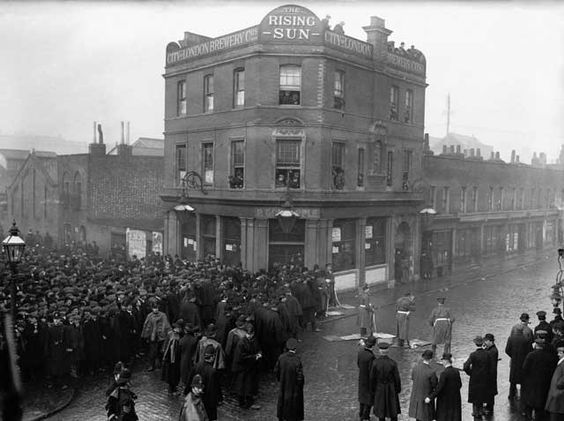
I presume we're all up to speed and fully au fait regarding the siege of Sidney Street? Peter the Painter? Good.
Essentially, Frederick Oughton's book The Siege Of Sidney Street is the novelization of the film of the same name made in 1960 starring Donald Sinden, Kieron Moore, and Peter Wyngarde. The screenplay was written by Jimmy Sangster who also wrote the screenplays for many of the Hammer horror movies and it's Sangster's screenplay that Oughton's book is based on.


The blurb on the back cover of the book is interesting as it reads like a Daily Mail headline and for that reason alone deserves to be quoted in full: 'The Day Anarchy Clutched At London. London's East End - January 3rd 1911. Bullets whine in Sidney Street, holding back hundreds of police, guardsmen and the Home Secretary - Winston Churchill. Three anarchist fanatics - Peter the Painter, Yoska, Svaars - had robbed and killed for their cause. Now had come the bloody day of reckoning... Here is a sensational story with a scaffolding of truth - of the gaslit, gin-soaked era when marauding anarchists took whatever they could grab.'
Sounds good doesn't it? I particularly like the phrase 'with a scaffolding of truth'. It could well be the Daily Mail. I must say, however, that the book actually takes a diabolical liberty with the truth but that's okay. Nothing wrong with that.
The historical, real life event is turned into a story of cops and robbers with a love interest, the twist in the tale to differentiate it from a hundred other cops and robbers stories being that the robbers are Russian anarchists, spurred on not by any desire to get rich but by ideology. They're appropriating money to help fund the revolution as explained to an incredulous police detective by an informer: "These people in London are anarchists, dey get money for friends in Russia." "To help them escape?" Mannering asked. Beran huddled deeper into his thick overcoat as though the temperature had dropped. "For der revolution. Der is going to be a revolution in Russia; dat is why dey want so much money. Revolutions costs money, sir."

And indeed they do. In my day, when me and my fellow comrades-in-arms wanted money for the revolution we'd call on Chumbawamba or any number of anarcho-leaning bands to play a benefit gig and they'd always oblige. In fact, when Chumbawamba were flush with the success of Tubthumping we wouldn't even have to go through the rigmarole of setting up a gig - they'd simply donate money straightaway, bless 'em - and much respect to them.
There's a lesson in this, actually. If Chumbawamba were around in 1911 then perhaps anarchist gangs wouldn't have needed to rob banks? Subsequently, when Chumbawamba were actively donating funds to anarchist causes not so long ago, perhaps in doing so they were keeping crime down? But I digress.


A good bit in the book is when the police detective is seeking information about the club where all the Russian immigrants congregate. He talks to the landlord of a pub situated opposite the club who is only too happy to offer up information about his neighbours: "It's a club a'right! Gawd, you c'n 'ear 'em jabb'r'n' away fifty ter the dozen right dahn the perishin' street. Club they calls it! Whore 'ouse more like! Gawd, you should 'ear 'em. I'll tell you somethin' else too. All they drinks there is tea. Tea. Round 'ere folks say as they're vegetarians."
"Perhaps they don't like meat, that's all," says the detective.
"Meat?" replies the landlord "Who said anythin' about meat? Vegetarians, that's what I said. That or them anarchists. Wouldn't be surprised to 'ear they was atheists too. Tell you, that club's got a bit of a name round this district, sir."
Vegetarians! And atheists to boot! How brilliant is that?

Another bit that deserves to be highlighted is when the anarchist Svaars is observing Peter the Painter saying goodbye to his lover: 'He would never have thought Peter was capable of such a display in front of others, for in the anarchist movement love was relegated to the level of sexual function, and nothing more, so as to avoid unnecessary entanglements and jealousies.'
Surely, that can't be right? I know it was decades later and he was no anarchist but Che Guevara once said "At the risk of seeming ridiculous, let me say that the true revolutionary is guided by a great feeling of love." I tend to go with that, personally. It's good to know who to hate, I believe, but you're on a hiding to nothing if you discount or give up on the notion of love. Or perhaps I'm just an old romantic at heart?


But where am I going with this? Well, The Siege Of Sidney Street is a ripping yarn and surprisingly violent and bloody in some of its descriptions. Whilst its stock in characters is fairly standard as in the world weary detective, the 'gangster's' moll (whom the detective falls in love with) and so on, the outcome is quite unusual in the fact that the 'villain' (Peter the Painter) escapes and it's the detective who seems to have lost the most because the woman he's fallen in love with has been killed by a stray bullet in the final shootout.
In reality, Peter the Painter was indeed thought to have escaped the Sidney Street siege and over the following years was reported to have been spotted in Australia and even on the Titanic. Such is the stuff of legends. To the consternation of the Daily Mail and the Metropolitan Police Federation, in Whitechapel, London, two housing blocks have been named after him and plaques erected explaining who this 'anti-hero' was.

Frederick Oughton's book is probably out of print now but as well as being a fairly enjoyable read, in its own peculiar way it too serves as a dedication to the memory of Peter the Painter and that fateful and historical day in Sidney Street.
And there's nothing wrong with that.                                                                                                                                                      John Serpico