Wednesday, 2 January 2019

Black By Design - Pauline Black

BLACK BY DESIGN – PAULINE BLACK

Just to show how little I know about The Selecter, I didn't even realise the name Pauline Black was a pseudonym. Pauline's real surname was Vickers and she changed it to Black initially to enable her to take time off work to play gigs without it leading to her being recognised and losing her job as a radiographer. And why 'Black' of all names? Well, as Pauline explains in her autobiography Black By Design: 'It was a statement of truth and intent all at the same time. Yes, I was black and I wanted to sing about what it meant to be black. But more than anything I wanted my family to finally say my name. Pauline Black. They could never bring themselves to say the B word. After years of being called half-caste or coloured, I could say it loud and proud. Pauline Black.'


To put this into context, when Pauline was a baby she was adopted into a white family where she had a white mother, father and brothers. Her adoptive parents held fairly traditional racist attitudes though it should be noted this was in the Fifties and early Sixties. Her adoptive parents desire for a baby girl apparently eclipsed the fact that she was black and blinded them to their own attitude to race. This was the backdrop against which Pauline grew up and it all makes for a fascinating read.

I understand how it appeals to some but usually I find reading about other people's childhoods a bit boring unless it's an unusual one. Pauline Black's was very unusual. I always presumed as well that she was from Coventry but actually she grew up in Romford, which makes it all the more strange because at that time there would have been very few people of colour there. She moved to Coventry to go to college and that's where she auditioned for lead vocalist in The Selecter, having cut her musical teeth singing Bob Dylan songs in local folk clubs. The past is indeed a foreign country.

Pauline's autobiography is a book that can be broken down into different parts. There's her childhood and early years, the Selecter years, her post-Selecter wilderness years, the genealogy years, and her Selecter epilogue years. Each part is going to be of more interest to some than others but I presume most people pick up her book due to having an interest in The Selecter and 2-Tone, and in this department Pauline certainly doesn't disappoint.
Amusingly, she's very forthright in her opinions of various people involved in 2-Tone, particularly individuals in The Specials. Out of all of them, Neville Staples comes out the best and is the one she offers up the most respect to even when telling us about the girls backstage being groomed 'for future sacrifice on the altar of Nev's cock'.

To Pauline's credit there is no love lost for the Sieg Heiling bonehead skinheads who flocked to the gigs: 'I'm sick of saying stuff in interviews about how 'lovely' it was on the 2-Tone tour. Some of these shirtless, bleached-jeaned, braces-dragging-round-their-arses bastards made it total misery. If you scratch their surface they have 'racist' written all the way down their centre like a sickly sweet stick of BNP rock'.
Of personal interest, Pauline writes about a specific gig The Selecter played in Bristol (my home town) at the Trinity Centre in September 1979. Her and dual vocalist Gaps are to be interviewed before they're due to go on stage so they traipse off with the journalist to a pub 'round the corner from the police station' opposite the venue. 'As soon as we walked in,' Pauline writes 'the landlady looked at us and pronounced audibly within the pub: “No, not in here”. A swift glance around the place showed me what she meant. No blacks in here.'
I used to live within walking distance of the Trinity Centre and I can't for the life of me figure out what pub it was that Pauline refers to. All I know is that whatever pub it was, it's certainly no longer managed by racists because if it was it would have been fire-bombed by now.

They return to the Trinity to conduct the interview there, only to have it interrupted by the promoter who begs that the band get on stage immediately so as to stop the growing tensions between the different factions in the audience. They do as they're asked but ultimately are unable to control the animosity between the Mods, the punks and the skinheads as fighting inevitably erupts 'like a forest fire finding dry tinder'. It's at this gig that Pauline realises it wasn't just about The Selecter spreading a message of 'unity' but about them being 'caught up in the maelstrom of competing teenage tribal factions'.
Cheers, Bristol. You're welcome.


Of all the 2-Tone bands, The Selecter were the most politically earnest and whilst this undoubtedly caused them problems it also made them a lot more valid than their peers. Madness and Bad Manners, for example, promoted their fun factor above anything else which led to greater success for them but also marked them as being lightweight. The Selecter had more substance. Importantly, Pauline understood their position in the scheme of things: 'We had been pushed up out of the masses, not imposed by some corporate music bigwig who wanted to have a bash at this new 'multi-ethnic' look. We were the real deal.'

Not that Pauline is without a sense of humour as revealed by a lot of the observations she makes and the anecdotes she relates, some of which it must be said being unintentionally funny. An amusing one is when she tells us about a time at the Melkweg in Amsterdam where she is given some Ecstasy. It's the one and only time she's ever taken it and ends up feeling a bit embarrassed about herself: 'Fortunately I was with a good friend who dragged me away from the young man who had become the object of my attentions. God knows what I'd been thinking. I had no intention of ever being counted among the ranks of that loony, perpetually grinning, bedroom-eyed breed again.'
You've got to laugh, really.

For all of this, however, the most affecting part of the book is when Pauline decides to search out her birth parents. It's the best part of the book, I would say. She discovers her dad is a Nigerian prince but has passed away and that her mum has emigrated to Australia. On finding her address, Pauline writes her a letter enclosed with photos and newspaper clippings from The Selecter's heyday. A week later she's wakened at 5 a.m. by a phone call:
'Blearily I groped around the bedside table for the phone. 'Hello,' I mumbled, rubbing sleep out of my eyes.
'Hello, is that you, Belinda?' (Belinda being Pauline's birth name.)
'Yes,' my soul blurted, before I could stop the word. I was suddenly super-alert.
'It's Mummy, darling.'
I couldn't help thinking that my mother sounded alarmingly like Dame Edna Everage!'
Following the whole build-up to this moment it's a curiously emotional piece of writing tinged with comedy that brings a lump to the throat and almost a tear to the eye.

Black By Design is a well-written memoir and Pauline should be really proud of it. As an insight into The Selecter and the whole 2-Tone movement it offers a unique perspective. Arguably, when it comes to the subject of 2-Tone it's better than Horace Panter's book Ska'd For Life if for no other reason than it being much more open about absolutely everything. For a start, Horace Panter never mentioned anything in his book about the altar of Neville Staples cock, that's for sure.
Far beyond such trivialities, however, as an insight into identity and the search for it, it's a fascinating read and this is actually where it's true strength and importance lies.
John Serpico

Thursday, 13 December 2018

Ska'd For Life - Horace Panter

SKA'D FOR LIFE – HORACE PANTER

The immediately refreshing thing about Horace Panter's book Ska'd For Life is that he doesn't spend the first half of it musing about his childhood and accidents he had on a tricycle at the age of three. Instead, it's straight bang into the music with brief descriptions of his first forays into playing in bands and then on to the Coventry Automatics and then The Specials. The reason for this is because Ska'd For Life isn't Horace Panter's autobiography but Horace Panter's story of The Specials and his part in that story as the bassist more commonly known to fans of the band as Horace Gentleman.


Horace is a man who knows what he likes and likes what he knows, who is rightly proud of The Specials but duly unimpressed by an awful lot of other things that came with the experience. A fair few bands and individuals are dismissed out of hand but respect paid where and to whom it's deserved. The Clash, for example, are praised and lauded to the skies whilst Generation X and anything related to them are shot dead.
As with a lot of people, The Clash impacted massively upon Horace, particularly with The Specials being invited by The Clash to support them on tour. Amusingly, Horace offers up two explanations as to why they were offered the support slot: the first reason being because Joe Strummer really liked them; the second because they could get Mick Jones some good sensimilla so were kept on as good herbal suppliers.

Horace highlights one of the gigs on The Clash tour as being pivotal to The Specials' proactive anti-racist stance, that being at a venue in Crawley where it's packed wall-to-wall with skinheads. The band realise that this malevolent and threatening audience being preyed upon by the extreme Right was going to be a major part of their prospective future audience as opposed to the punk audience they had previously been attracting. The times they were a-changing, or as The Specials put it: it was the dawning of a new era.

The rise of The Specials coincided with the rise of Thatcher which meant for a band such as them there was no way they would be able to avoid the fall-out from her policies even if they had wanted to. Violence that had been specific to football terraces was transferring to the concert halls and no band was safe from it, particularly those who were attracting a skinhead audience. Thatcherism had given the green light to Right-wing politics and with this the extreme Right were making hay whilst the sun shone. A lot like Trump nowadays come to think of it.


When writing about audiences and other bands, it should be said that at times Horace seems not to see the wood for the trees. An example of this is when he describes the UK Subs as 'punk cannon fodder' and their audience as being 'Neanderthal' – which is pretty discourteous, to put it mildly.
Horace may not have liked the UK Subs' music and that's fair enough but them and The Specials actually had a lot more in common than they had differences and it was the commonalities that should have been built upon not the differences exasperated. They were both strongly anti-racist for a start and in such times as those when unity was required, to dismiss fellow anti-racists is not a good move, really. To describe the UK Subs' as 'punk cannon fodder' also displays a profound misunderstanding of punk. And if the UK Subs' audience was Neanderthal then what did that make The Specials' audience? Troglodyte?

Hindsight, of course, is a wonderful thing but at the time there wasn't any clear idea of what to do about fighting at gigs. The resurgence of skinhead as a fashion meant that for a lot of those following it the whole kit and caboodle was being adopted, from the dress sense and the favoured bands right down to the perceived politics.
At the time there was no distinction between the 'real' skinheads and the boneheads inspired by the Oi! Scene. They were all just skinheads, some of them good but a lot of them right horrible bastards suddenly being allowed to be horrible as a prerequisite of the fashion they were following.

Horace mentions at one point in his book a gig where there is seig heiling during the song 'Why?', specifically at the line 'With a Nazi salute and a steel-capped boot, you follow like sheep in a wolf's clothes'. As with all dedicated fashion followers, skinheads (or a lot of them, at least) would adopt anything to bolster their identity no matter how ridiculous it might be. So, a line from a song that is explicitly anti-racist is turned around and used as a celebration of racism and of identifying with being racist. Like I said – Troglodyte.
That's not to say The Specials' audience was all like this – far from it – because their gigs were in actual fact joyous celebrations of just being young and having fun. 'Enjoy yourself', as they urged in the song of the same name 'It's later than you think'. And their fans took heed and people actually started dancing again at gigs and invading stages, much to the chagrin of Horace who whilst loving the dancing was in two minds about the stage invasions.


On reading Horace's book, I never realised The Specials played their last UK show in July of 1981 whilst Ghost Town was still at number one in the Charts. July 1981 being, of course, the time of the urban riots that erupted throughout the country to which Ghost Town was the soundtrack. You live and learn.
Ska'd For Life contains plenty of other details and anecdotes such as this to create what is a veritable treasure trove for any self-respecting Specials fan. Whether or not it's actually the best book ever written about The Specials (as has been said) is hard to say. It's good but it's not the defining book by any means but then such a book is probably never going to be written due simply to there being ten members of the group and therefore ten different perspectives. Jerry Dammers story is going to be the most interesting but it's advisable not to hold your breath while waiting for it.

For the record, my most favourite anecdote in Ska'd For Life concerns not any of The Specials but their manager in the early days, Bernie Rhodes. Bernie, as we know, was also the manager of The Clash. 'One day we were in his office' Horace writes 'He came in, picked up the phone, dialled and said “Topper! It's Bernie. Stop hanging round CBS – it cheapens the whole thing”, and put the phone down.'
Whether or not anyone was actually on the other end of the phone and Bernie was just saying it for effect – to make an impact upon The Specials – doesn't really matter, though imagining a perplexed Topper on the other end is quite amusing. It would have been a typical Bernie Rhodes thing to do but none the less brilliant for that.
For Bernie Rhodes and The Clash the image was total. And so too for The Specials...
John Serpico

Thursday, 29 November 2018

Post Office - Charles Bukowski

POST OFFICE – CHARLES BUKOWSKI

When I first read Post Office by Charles Bukowski as a teenager I didn't really rate it. Reading it again years later, however, I appreciate it much more and am duly impressed. Why might this be? Age and experience, I presume? As a teenager I would have had little concept of the world of work apart from the fact that I didn't wish to get too heavily involved in it. Having now worked at a variety of jobs of the kind that Bukowski writes about in Post Office, I can now understand where he's coming from. In addition, now that I know a bit more about Bukowski and thanks to YouTube have now heard his beautiful voice, I appreciate him much more as a writer.


Post Office is a book that probably everyone should read, particularly those stuck in low-paid, menial, exploitative jobs. And believe me, that's a lot of people. Bukowski nails it again and again by highlighting all the small but universal things that come with having a crap job. The low pay (of course), the impossible hours, the petty rules, the strict productivity, the impossibility of saving anything from the low wages, the overtime to make ends meet, the mealy-minded managers, the constant tiredness, the resultant ill health, the high turnover of staff, the cretinous work colleagues, the constant fear and threat of dismissal, the repetitiveness, the stupidity, etc, etc.

That's not to say it's all doom and gloom because when you're working in a low-paid, menial job there is always a dark humour to it. For those who have a sense of the ridiculous there is never ending laughter to be had either at your own expense or the expense of those in job positions above that of your own.
And so it is with Bukowski's Post Office. There is a sense of humour that pervades the whole book be it when he's writing about his job or when he's relaying comic tales from his social life. Alongside this there is also madness, sadness, celebration and hope. All the stuff of life, essentially.

Bukowski weathers the storm and at the end makes his move to a better life by resigning from his job after enduring it for twelve long years. Not to move into better employment but to move away from employment altogether for the sake of his health, his sanity, his soul – and for the hell of it.
'Maybe I'll write a novel,' Bukowski thinks to himself. And so he did, and he called it Post Office.

There's a quote by Charles Bukowski where he says: 'How in the hell could a man enjoy being awakened at 8.30am by an alarm clock, leap out of bed, dress, force-feed, shit, piss, brush teeth and hair, and fight traffic to get to a place where essentially you made lots of money for somebody else and were asked to be grateful for the opportunity to do so?'

Is this not a universal truth? There are jobs that can be enjoyed, of course, and there is such a thing as the dignity of labour but when you're talking about low-paid, menial, exploitative jobs this all goes out the window. The tragedy of it is that a huge swath of people have no other option but to work in such jobs if they wish to survive in the world. You work or you starve. You work or you lose your home. You work or you die. Or so we're led to believe. The even greater tragedy of it is that still to this day nothing is very different to how it's always been and in many ways is actually even worse now.


It's just the way it is, you might say? And you wouldn't be wrong. But does that mean it's just the way it's always going to be? Does that mean it must only get worse, with all those stuck in the drudgery of rubbish jobs being ground down ever further year after year, generation after generation?
There must be some kind of way out of the poverty trap, surely? And there is. For the individual – on their own – there are indeed ways to strike out for a better life. In Post Office, Bukowski writes his way out using the subject of his job at the post office as source material, along with tales of his life in the gutter as he looks up at the stars. And that's fine. That's all well and good. But rather than individuals escaping one at a time, what is really required is for there to be a mass breakout, for everyone to escape en masse and for there to be no-one left behind. For until all are free, none are free.
That is the dream...
John Serpico

Thursday, 22 November 2018

Under Exmouth skies (Part 46)

UNDER EXMOUTH SKIES (Part 46)

It seems like only last week when it was summer and I would at the end of a day sit and watch swallows fly into the setting sun...

Friday, 16 November 2018

Twisting My Melon - Shaun Ryder

TWISTING MY MELON – SHAUN RYDER

I'm sorry but when I look at the cover of Shaun Ryder's Twisting My Melon autobiography all I see is a nose. It's a very weird nose he's got, don't you think? Like a proboscis monkey. I wonder if the vote on whether or not to use this particular photo for the cover was unanimous? I mean, if you're going to have a photo of Shaun on the cover of his autobiography then surely it should be the one of him inside a letter 'E', as featured once on the cover of the NME? The publishers obviously had the same thought but they've opted instead to use just a part of that photo for the back cover. I wonder why?
And if you can manage to tear your gaze away from Shaun's nose for a moment, what is that look he's giving? Is that his 'come to bed' eyes? His 'come hither' look? Thanks, Shaun, but I think I'll sleep on the couch tonight if you don't mind?


There's something incongruous about the cover as well, as in the banner headline at the top declaring 'The Sunday Times bestseller'. Maybe it's me but my perception of the Sunday Times and my perception of Shaun Ryder are at complete odds with one and other. I don't understand at what point the two worlds meet. I just can't imagine Shaun telling us how much he appreciates the Sunday Times aesthetic when it comes to art and their approach to it, and how his weekend isn't complete without digesting the thoughts and political insights of their columnists. Just as I can't imagine the Sunday Times writers applauding and pontificating over the merits of petty theft, drug taking and tales of growing up on a shitty council estate in Salford. All over a few glasses of Pinot Noir and some little saucers of nibbles.

There's a clue, however, in the quote from the Sunday Times displayed prominently on the cover where it says 'Fantastically entertaining... a seamless, authentic, exhilarating read'. It's that word 'authentic'. It's a very middle class word, I think. It's the kind of word used by middle class writers when they describe something or someone they like but would never choose to inhabit the place where that same something or someone is coming from. It's a word used to recuperate something (or someone). And it begs the question: Is the Sunday Times advocacy and promotion of Shaun Ryder's autobiography a way of recuperating an aspect of working class culture?

Am I making too much of this, I wonder? Well, possibly not because Shaun even touches upon it himself when talking about the Wrote For Luck video: 'The Manchester Evening News would never really touch us as a band, before we made it, and part of that was because we were the sort of people that they would cross the street to avoid if they were coming out of a pub late at night in the centre of town. A lot of people in the media were a little bit frightened of what was happening at that time, because they just didn't get it'.
Not that Shaun could care less about such a thing so long as he was being paid top dollar for it. More fool the media, if anything.

'Come hither...'

As almost to be expected, Shaun's story steps up a gear when the E starts making an appearance in the summer of '87. Up until that point Happy Mondays were just another Northern Indy band struggling to establish themselves in the wake of Joy Division and New Order. Rather cruelly but succinctly, Julian Cope summed up the Mondays at that time (dressed up in their anoraks and cagoules) when he said of them: 'Who do they think they are, the fucking Undertones?'. An observation the Mondays didn't take very kindly to.
The E, of course, changed everything and being right in the middle of it, Shaun's take on the whole subject is a valid one: 'I knew idiots who would go out and fight and stab people, people whose whole night was about going out and kicking off in a bar and having a fight, or going to the match and kicking off. That's what it was all about for them, but once they started taking the E, that fucking shit stopped. It's a cliché, but it's absolutely true. You could see everyone really loved up, and yet at the same time you're reading in the press about this killer drug being the downfall of society. It was complete bullshit and it just makes you wonder about what other bullshit they are feeding you'.

It must be said, there was no great meaning to the Happy Mondays. No insights, no pertinent message, just hedonism essentially. The Happy Mondays were a vibe, a groove, an attitude, a nod and a wink. Represented perfectly by Bez, a man whose sole contribution at first sight seemed only to dance on stage with them whilst shaking some maracas but in actual fact was the key to the band. The Happy Mondays could have been a silent disco. In fact, if you watch a Happy Mondays video (such as the one for Wrote For Luck) with the sound off you get just as good an idea of what they're about as you would by watching the video with the sound on.
And no matter what Tony Wilson said about Shaun's lyrics on a good day being are on a par with WB Yeats on an average day, though he possessed a distinctive voice he was no great lyricist. Never did he come out with anything on a par with (for example) Higher Than The Sun by that other great 'E' band, Primal Scream. Or even anything by The Shamen, come to that. Shaun's lyrics were psychobabble. Words strung together simply because they sounded good. And Shaun's happy to admit it, so it's not a criticism at all.

I saw the Happy Mondays that time when they played Glastonbury, when it was the mud bath and they'd snuck a photocopier in so they could duplicate back-stage passes for their entourage. They were a suitable shambles but then if they had been slick and professional they wouldn't have been living up to expectations. The funniest thing about them, actually, was their fans in their flares. It was the most unsuitable trousers for such conditions as you could get. Caked in mud, their flares must have weighed a tonne as they dragged themselves around the site. Suffering for fashion, I guess, but as Joe Strummer once said, 'like trousers like brain'.

Twisting My Melon is over 400 pages long so it isn't just a quick read. It would obviously be beneficial when reading it to be a Happy Mondays fan but if you're not, it's a bit of a challenge. For all that, it's an entertaining romp if scamming, crack cocaine and an unspoken fear of the working class is your bag. Which might explain why the Sunday Times like it so much...
John Serpico

Tuesday, 6 November 2018

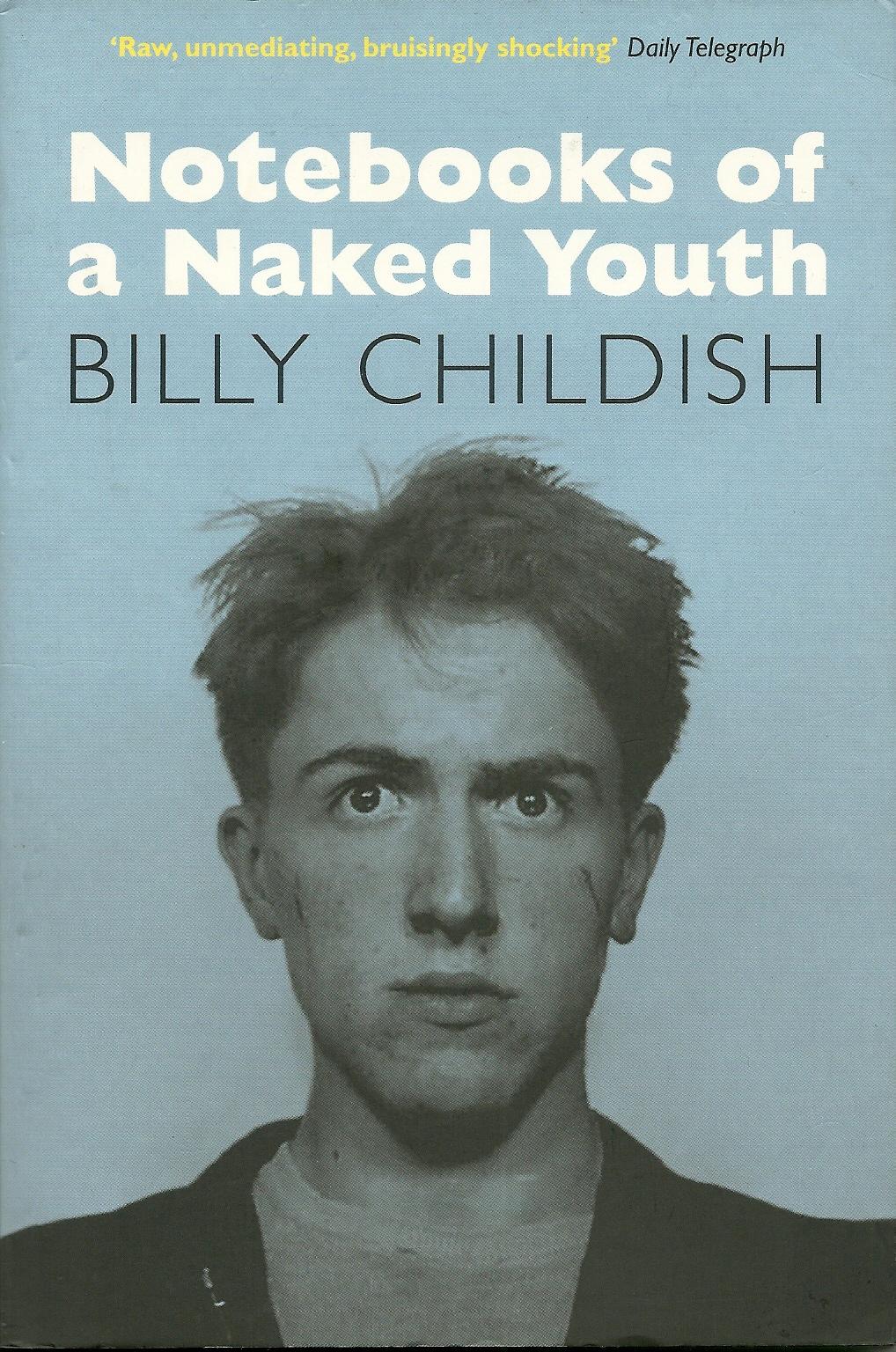
Notebooks of a Naked Youth - Billy Childish

NOTEBOOKS OF A NAKED YOUTH –
BILLY CHILDISH

I admire and respect Billy Childish – the man, his music, his art and his moustache. He also still gets my vote for being the Greatest Living Englishman. Unfortunately, there's something about Notebooks of a Naked Youth - his sequel to his début novel, My Fault - that makes it inferior to it's predecessor rather than being it's equal or even its better.
There's a sense about it of being a work in progress, as if there was no clear aim as to where the book was going to go or of even what kind of book it was going to be. It starts off as if this time Childish is playing it for laughs and effecting a style of writing that displays his somewhat dark and twisted sense of humour. It ends up as a sort of bastard child of William Burroughs and Henry Miller.


The narrator's voice is that of an imbecilic child inside the body of a young adult, or of someone with Aspergers who doesn't know how to properly relate with other people. It's rather like the Paddy Considine character in the Shane Meadow's film A Room For Romeo Brass. Is it an affected voice, I wonder? A fictional voice utilised to relay the story? Or is it Billy Childish's actual voice? I don't want to give offence but it's hard to tell. Either way, though it's a disturbing voice it's noticeable that it's not such an intense voice as that heard in My Fault.

Between the comical narration there are indeed plenty of disturbing episodes such as when the author is stalking a 15 year-old girl, or when he's stopped by the police and they see he's wearing a trick toy ring water pistol – and they ask him if it contains drugs? Or when he's about to have sex with 'the Jewish lady' and he suddenly remembers lying in bed with 'uncle' Norman who's tugging his trunks down round his knees and whispering 'Can you keep a secret?' Or when he's on a bus and he accuses all the other passengers of having 'mind mirrors': “You think that I don't know that you've all got mind mirrors?” he shouts “You think that I don't know that you can look into my darkest thoughts? You think that I'm mad, that I'm sitting on this bus amongst you strangers and that I don't know that you all have mind mirrors! Go on, cross your gangrenous legs and hold your newspapers to your noses like I'm invisible, all the while secretly studying me with your hideous, disrespectful, hypocritical mind mirrors! Ignore me then, damn you! But don't think for one minute that I don't know all your names and addresses, you scallywags!” We've all met this person before, haven't we? On the Underground, at the shopping centre, or even on the bus? The person we try to ignore and keep away from in case he turns his attention explicitly upon us?
Billy Childish is that person.

What is even more disturbing about the book, however, is the blurring of the lines between fantasy and reality, and between fiction and fact. Did Childish really fuck a dog? Has he really killed a little girl and her tiny, bird-like body now lies hidden in his blue cardboard guitar case? Who knows? It's feasible. Is this a work of fiction or a memoir? The edges are so blurred that it's hard to tell.

Billy Childish is an extremely interesting character which makes for anything he creates being equally interesting; be it art, music, poetry or prose. For all its faults, Notebooks of a Naked Youth easily falls into that same canon.
                                                                                                                                        John Serpico

Tuesday, 23 October 2018

The Vagabond's Breakfast - Richard Gwyn

THE VAGABOND'S BREAKFAST –
RICHARD GWYN

Richard Gwyn? No, I've never heard of him either. But just because we don't know the name of an author doesn't mean we should ignore him because if we did that all the time we'd still only be reading, for example, Jeffery Archer. Which raises an obvious question: What is it that attracts us to certain books? Mostly it's what's on the spine, of course, because that's all we initially see when on a shelf. So it's going to be the author's name, the title, the design, the publisher, the colour, or even the hype and a good publicity campaign. Not to mention what Jung termed 'synchronicity' – but that's a whole other story.
On pulling out the book we initially look at the front cover, then the back cover for the blurb, then we open up the book and choose a page at random (never the end) and read a snatch of it. On these things we make a decision as to whether we buy the book but more importantly, whether we are going to devote our time and attention to it. Whether we are going to give a portion of our lives to it.


And so to The Vagabond's Breakfast by Richard Gwyn. I presume it was the title that first caught my attention because I didn't know what it meant? Or perhaps it was synchronicity? The cover at a glance was nondescript and gave away no clues. The blurb on the back on scanning it said something about 'vagrancy and alcoholism in the Mediterranean, principally Spain and Crete'. On opening a page at random I fell upon the author expounding upon the imbibing of datura on Crete.
I bought the book.

Richard Gwyn is the Director of the MA in the Teaching and Practice of Creative Writing at Cardiff University, or at least he was when this book was published in 2011. Before this, however, he had spent 10 years as an itinerant worker/vagabond alcoholic in countries around the Mediterranean, some of those years being on the island of Crete.
Gwyn cleverly weaves his memoir between tales and anecdotes from those times and his present day situation where he is suffering from insomnia whilst waiting for a liver transplant due to contracting hepatitis C; all interlaced with thoughts and meditations on various subjects dear to him. It all makes for a surprisingly good and very beautifully written book.

As a teenager I also lived in Greece for a few years living the life of a traveller and for a couple of those years I too lived on Crete where I worked on building sites and farms and in saw mills and factories. I lived in pension houses, proper rented houses, in community shared houses and for long periods of time in no house at all, choosing instead to sleep on beaches, in woods and on mountains. I was a beach bum, a mountain boy, a Cretan cowboy. This, coincidentally, was at the same time as when Richard Gwyn was there.

Did I meet him? I'm not sure. We were certainly moving in the same circles and crossing paths with the same kind of people. I met so many different characters during that period that it's hard to recall all of them after all these years although the name of one of the people Gwyn talks about – a German called Hubert – certainly rings a bell.


In his book, Gwyn describes the kafenions populated by 'carousing travellers, the post-punk detritus of northern Europe and stoned hippies who had got lost on their way back from India'. I too have met these people in similar eateries. He describes hauling bags of cement up flights of stairs when labouring on so-called Cretan construction sites. He describes working in the giant green houses, picking tomatoes, cucumbers and bananas in the suffocating heat. These things I too have done.
He writes about the Romany gypsies of Crete who I too have travelled with, romantically viewing them at the time as being like gold-toothed Apache indian warriors. He writes about the kamakia of Crete, the local boys who were basically studs servicing the tourist women on holiday from Germany and Sweden. I had been wearing a Crass badge at the time – the anarchist symbol with the snapped sub-machine gun above it – and the local kamakia befriended me because of that badge. They knew nothing about Crass but they knew what anarchy was.
And he writes about datura, otherwise known as jimson weed, a wild-growing plant found in Greece that just also happens to be a very powerful hallucinogen.

Gwyn describes his experience of imbibing the seeds of the datura plant in a very open and honest manner, neither deluding himself about nor denying what occurred during his trip and neither exulting or downplaying the experience. He admits that at the time he knew very little about datura apart from the reading of Carlos Castaneda books, this being very understandable. There was no Internet back then so these kind of things were very hard to reference. Nowadays you can look up 'datura' on Wikipedia and even view footage on YouTube of Terence McKenna advising to be very wary of the plant. Back then, however, you just took the big plunge, as Patti Smith once put it.

'In terms of hallucinogenic experience,' Gwyn writes 'datura is a world apart from LSD or mescaline: recreational it is not. It will, if such language has any meaning, attempt to infiltrate the soul. Specifically, I was made acutely aware of the existence, parallel to our own visible world, of a wondrous and terrifying otherworld in which we were unwitting participants. That this otherworld was as real as the one we normally inhabit was never in doubt while under the influence of the datura plant. I still retain the vivid impression that for one night and part of the following day the veil between these worlds had been removed.'

During my time on Crete I too imbibed datura seeds but unlike Gwyn I'd never read Carlos Castaneda so knew even less about the plant than what he did. Little did I know that it was a plant that such people as Nepalese shamen and holy men specialised in taking.
Years later, I recall very little of the experience apart from a distinct feeling of levitating 15 feet in the air and seemingly seeing, sharing and experiencing other people's dreams and hallucinations. The sense of the 'otherworld' was also palpable, where every word spoken was loaded to the max and every gesture, every touch, every glance was unspoken communication conveying volumes. No Howard Marks was I but I do recall coming back to the UK with a tobacco tin full of datura seeds to distribute to interested parties though I never took them myself again. Without any doubt, datura is the most strangest drug I've ever taken and it would appear that Richard Gwyn might feel the same.

The datura episode Gwyn writes about, however, is but one very short chapter and in no way is The Vagabond's Breakfast solely a drug book. In fact, I wouldn't even say alcohol is a major theme in the book either. Richard Gwyn's memoir is instead a story about the getting of wisdom. It's the story of the author losing himself so as to be able to find himself. Above all, I would say it's a very inspiring example of how to write a very good book indeed.
John Serpico