John Lydon's come out with so many good lines in His songs over the
years that it's hard to choose which one might be His best. Howard
Devoto once stated that what John writes is sheer poetry and I almost
agree. I mean, it's not consistently sheer poetry by any means but
He's had his moments. For John Himself, 'Anger is an energy' is
possibly the most powerful one-liner He's ever come up with, hence
using it as the title for His autobiography.
Autobiography? John Lydon? Haven't we been here before with 'Rotten -
No Irish, No Blacks, No Dogs'? Well, yes we have though according to
John that one wasn't so much an autobiography but more of a setting
the record straight following Jon Savage's 'England's Dreaming'.
Whatever. But who in 2015 would think there was anything left to say
about the Sex Pistols/John Rotten/Lydon/PIL, etc, that hasn't already
been said? Well, obviously John Lydon for one and you know what? He's
not entirely wrong. Anger Is An Energy - My Life Uncensored
contains a fair few tasty nuggets, morsels, insights and
revelations that they make it a joy to read; the only problem being
that it's sometimes hard to decipher the truth from the fiction, the
opinion, and the revisionism. But who am I to argue because
the bottom line of it is that John was there and I wasn't. Hundreds
of other people have given their versions of events regarding the
Pistols, Punk and the subsequent fallout and why take their versions
as the truth and not His?
So what do we get? For starters we find out about John's musical
influences and some of them come as a surprise, to me at least.
According to John, Status Quo are "Fantastic rock. Wonderful,
brilliant, beautiful stuff." He also adored Alvin Stardust,
David Essex's 'Rock On', and Gary Glitter's 'Rock And Roll (Part 1 &
2)'. He also likes Arthur Brown, Can, Faust, Nico, Dr Feelgood, the
Kinks, a lot of reggae, and Duran Duran. That's right, Duran Duran.
In addition He loves Ted Hughes and Oscar Wilde, and has read
Dostoevsky.
Apparently Mick Jones of The Clash is "a lovely person,
really warm", Paul Simonon is "a posh kid, from a
good background", Chrissie Hynde is "a very
important person in the world", Robert Plant is "a
great fella", and Keith Levene is "a cunt".
Guests who turned up at His house in Gunter Grove included Joan
Armatrading, Althea and Donna, composers John Barry and Stomu
Yamashta, and Les Mckewan of the Bay City Rollers.
Whilst working briefly at Sex, John sold newscaster Reginald
Bosanquet a skin-tight rubber top. If you know who Reginald Bosanquet
is and know what he looked like - can you imagine? The
original idea for the Anarchy tour was to pair up with a circus and
tour that way. Richard Branson wanted John to be the lead vocalist of
Devo. Whilst involved in initial preparations for the Sex Pistols
movie, John put forward Graham Chapman from Monty Python to direct it
(as opposed to Malcolm McLaren's first choice of Russ Meyer). John
auditioned for the lead role in Quadrophenia which in the end, of
course, went to Phil Daniels. And as of 2013, John now has American
citizenship.
According to Sid Vicious, Vivienne Westwood was a "turkey
neck", and Paul Cook "an albino gorilla".
Sid's mum would give her son devilled kidneys sprinkled with heroin;
and when Nancy Spungeon was found murdered at the Chelsea Hotel, Mick
Jagger got his lawyers sent in to protect Sid. And on that subject:
John suggests Nancy was killed by New York drug dealers to whom Sid
owed money.
Is any of this of any importance? Is anyone interested? Listen: The
Sex Pistols were a bright, shining beacon of hope that offered
inspiration and something a whole lot better to anyone desiring it.
"I want more life, fucker." said Rutger Hauer's
replicant android in the film Blade Runner. The Sex Pistols and Punk
Rock offered more of everything - life included. The Pistols blew a
hole in British culture and in the created space the Punk banner was
raised. In towns and cities across the country whole armies of little
Oliver Twists' stood up and poured into that space, all with one
thing in common: They wanted more.
"We opened all the doors - and the windows." said
Sid Vicious, and he wasn't wrong. By 1979, however, Sid was dead and
the original Punk explosion had been accommodated, contained and
diluted leaving only sparks and streamers descending from the skies
and seeds drifting through the breeze. But what fires those sparks
did light and what strange and brilliant fruit did those seeds yield.
Tittle-tattle regarding such things as Sid's mother putting heroin on
his dinner is, of course, totally irrelevant in the grand scheme of
things but the importance of the Pistols and Johnny Rotten upon
Britain and indeed many other parts of the world should not be
denied.
Without his fellow Sex Pistols, John would have been just another
misfit roaming the streets but without John the Sex Pistols would
have been just another rock'n'roll band. Without John and His Sex
Pistols no band of any substance or merit over the last few decades
would ever have existed, or at least not in the same form. But then
without His working class origins and all the influences upon Him,
John would never have been the same person, which is why it's
interesting to read who and what did influence Him - including even
Alvin Stardust.
"You don't write a song like 'God Save The Queen' because you
hate the English race." said John "You write a song
like that because you love them and you're fed up with them being
mistreated." And for His troubles John suffered rebuke,
hostility, condemnation, physical attacks and police raids. At times
it must have felt as though the whole world was against Him.
John doesn't owe us anything but we all owe John. He's earned the
right to do absolutely anything He chooses and not only does that
include reforming the Pistols to make money but also going on I'm A
Celebrity and doing ads for Country Life butter. Is anyone so pure
and effected so much change for the good upon the world that they are
in any position to criticise Him? I think not.
There are bits in Anger Is An Energy which are really good such as
when John's talking about being dropped by A&M, instigated by
Herb Alpert - the 'A' in A&M - who sent a communiqué from LA to
the UK label's office saying he didn't want such undesirables as the
Sex Pistols on his label. Years later when John's living in Malibu,
who might His neighbour be? None other than Herb Alpert. "There's
a difference in the size of our respective properties, let me tell
you. He has half a mountain." John writes "But I
know it more than bugs him that I live here. Talking with the
neighbours, they've told me so. Well, that's your comeuppance, you
fuck."
Some bits are really moving, particularly when He talks about the
death of His father: "At dad's funeral, I was borderline
passing out with tears, which I never did with my mum. I was expected
to give something of a speech. I couldn't, I just couldn't. Words
fail you. I walked up when I felt like it and I leant into the
coffin, and I kissed my dad's dead body on the cheek. I looked down
and went, 'That's me dad!' and broke apart. I missed him so bad."
And then there are bits which are the Johnny Rotten we all know and
love such as when talking about the Establishment lining up against
Him during the Pistols' heyday: "Why aren't you (the
Establishment) supplying us with jobs and a decent lifestyle, you
fucks? You're going to tell me to shut up because I'm finding the
economic situation you put the country in a problem? And using that
very thing that they just love to espouse in the West, democracy!
Ooooh - the right to say what you have to, to stand up and be
counted. Wow. Didn't I blow a hole in that bubble. And seriously, a
BIG hole in that bubble. I found that to be an absolute non-truth. I
wouldn't tolerate it. And still won through. So there you go, boys
and girls of the world, Johnny did his bit for ya. Fucking say
thanks, cunts."
Down here in Exmouth, Anger Is An Energy is not only on sale at WH
Smith but is also available from the public library, and copies are
even now popping up in charity shops. It's ubiquitous and I can only
presume this is a good thing? But let's keep this in perspective
because at the end of the day it is simply an autobiography, nothing
more and nothing less. The person it's about, however, is one in a
million.
Not so much street art Exmouth style but art all the same and in Exmouth. Up on top of Orcombe Point at the western end of the Jurassic Coast you'll find a compass rose near to the cliff edge pointing to Woodbury Common, Sandy Bay, Dawlish Warren and the 250 million years old Triassic rocks out on the sea bed. And when standing there taking in the view what song might spring to mind? Why, Jah Jah Call You by World Domination Enterprises, of course.
Is life an illusion and love but a dream? Is beauty in the eye of the
beholder? Is art subjective, or objective? Is art a mirror? Or a
hammer? Upon such complexities I sometimes ponder. What makes for a
legendary band? And what makes for a classic book?
At this moment, that latter question is the one I'm asking myself.
Every once in a while a list is published of 'The 100 Greatest Books
Ever' or 'The Best 100 Novels', or there's such books as '100 Books
To Read In a Lifetime'. These lists always contain the most obvious
books such as Ulysses or Moby Dick both of which, as examples, I
would heartily agree belong in the top 10. Ulysses, in fact, often
makes the number 1 spot though more often than not with the proviso
of 'begun by many, finished by few'. I happen to have read Ulysses
twice now and it gets my vote too for being the greatest of books.
There are some, however, that appear in these lists that I'm in
complete disagreement with. On The Road by Jack Kerouac? It's good
but it's not his best. Finnegan's Wake by Joyce? Life just isn't long
enough. The Secret Agent by Joseph Conrad? Very debatable. And then
there's Brave New World by Aldous Huxley.
Having just read it, I must say that frankly I'm not impressed. I dig
Huxley's groove, as his acolytes might have said in the Sixties but
in no way is Brave New World one of the greatest books ever.
For anyone not au fait with the story, it depicts a future society
where everybody's happy; this state having been achieved through the
advancement of and domination by the forces of capitalism and
science. People are no longer given birth to but instead are hatched
in test tubes then during infancy inculcated through subliminal
messaging virtues such as passive obedience, material consumption and
unrestricted copulation. In later adult life the population is kept
occupied by sports, mild labour and mindless entertainment, and kept
under sedation by a freely distributed drug by the name of soma.
We are introduced to Lenina and Bernard who in their own particular
ways and for their own particular reasons are not quite content with
the ways things are. Together they visit what is called a Savage
Reservation in New Mexico; a place where primitive civilization still
exists and where people still marry, give birth, die of old age, and
use such antiquated terms such as 'mother' and 'father'. There they
encounter a savage called John and his mother, Linda, who are brought
back to London. The mother ends up strung out on soma before dying,
whilst John ends up as a freak to be gawked at until after being
unable to take any more, hangs himself.
This is, of course, just a brief synopsis of the story-line and isn't
really doing it justice because the true point of Brave New World as
I see it, is for it to be a vehicle for ideas. And what are those
ideas? Well, I presume Huxley knew what he wanted to say when he
started writing the book but a lot of it feels as though it was being
made up on the hoof. It's as though he took bits and pieces from
here, there and everywhere, and tried to knot them all together into
a coherent whole. He didn't exactly fail in his task but when main
characters are given names such as Marx, Bakunin, and Lenin it just
comes over as a bit... ham-fisted.
Huxley depicts a future society where the human spirit has been
extinguished and where the control systems that maintain the staus
quo are all that matters. He also depicts a savage society where
science doesn't exist and the human spirit is apparently unfettered.
The problem, however, is that both societies are shown to be just as
bad as one and other. There's a false dichotomy between them and
presumably this was fully intentioned - to present both worlds in the
same dim light? So, on the one hand Brave New World warns against the
danger of a totally controlled society yet also despairs at an
uncontrolled society.
Now, in a foreword written 14 years after the first publication of
Brave New World, Huxley considered adding a depiction of a third type
of society to his story; one where economics would be decentralist,
science would serve rather than dictate, and politics would be
Kropotkinesque. An anarchist society, essentially. He obviously chose
not to do this but I rather wish he had because if Brave New World is
a vehicle for ideas then perhaps it would have done away with any
ambiguity about those ideas.
There are a lot of readers who like Brave New World precisely because
of the ambiguity of it but for me, all it does is to shift attention
away from what the book is meant to be about and on to the author
himself and where he's coming from. And of course, where Huxley's
coming from is the public school education system of the early 1900s
- Eton, to be precise. And however much of a freethinker Huxley
presented himself as, he would still have been inculcated with all
the attitudes and indeed, prejudices that would have come from such
an education. You don't have to look far into the book either to see
these attitudes on full display, particularly in the hierarchical
make-up of his controlled society where there is a class of
Alpha-Plus intellectuals who are bred to govern and a mass of
Epsilon-Minus Semi-Morons bred for menial labour.
When first published in 1932, Brave New World was viewed as being
prophetic and has been deemed as one of the most influential and
important books of the 20th century. I've no argument with it being
prophetic as indeed, Huxley has in many ways been proven right - more
so, in fact, than George Orwell in his own particular vision of the
future, 1984.
Brave New World, however, is now out of date because social control
systems (rather by accident than by design, I feel) have superseded
anything Huxley envisaged and we are now (or at least those in the
First World) in what is essentially a virtual state. We are removed
from what might actually be reality and are living and thinking in a
virtual reality where our opinions, thoughts, ideas and perhaps even
our dreams are not our own but simply versions of others. And when I
say 'virtual reality', I don't mean as simulated by computers or the
Internet but as in shadows of the form and substance of life itself,
those shadows being far more complicated than they ever were in
Huxley's day.
I suspect that some years after Huxley wrote Brave New World, he
himself began to realise that his book was a mere tinkering around
the themes he was exploring - simply an entertaining sideshow; which
would explain his growing interest in mescaline, leading to him
writing what is probably his most famous essay, The Doors of
Perception.
Compared to say, Slaughterhouse Five by Kurt Vonnegut Jnr, Brave New
World has now lost its power and I suspect also that if Huxley were
around today then he too would refute the idea that it's one of the
greatest books ever, and that puts me in good company. Me, the
uneducated lout from a council estate in Bristol, and Huxley; a
polymath of the highest order and one of the greatest British
thinkers of all time....
I may even have one up on Huxley because I've got a sense of humour
and as far as I know, Huxley was never really renowned for his jokes.
I must admit, however, that until reading Brave New World I never
realised that it took its title from Miranda's speech in
Shakespeare’s The Tempest: "How beauteous mankind is! O brave
new world that has such people in it." And also that the song
Everybody's Happy Nowadays by the Buzzcocks was derived from it....
As is my wont, I sometimes wander lonely as a cloud to the end of
Exmouth beach, past the sign that says 'Need to talk? Phone the
Samaritans' and up onto the cliff edge. There I gaze out to sea and
watch the gulls gliding, the cormorants diving, and the waves
crashing.
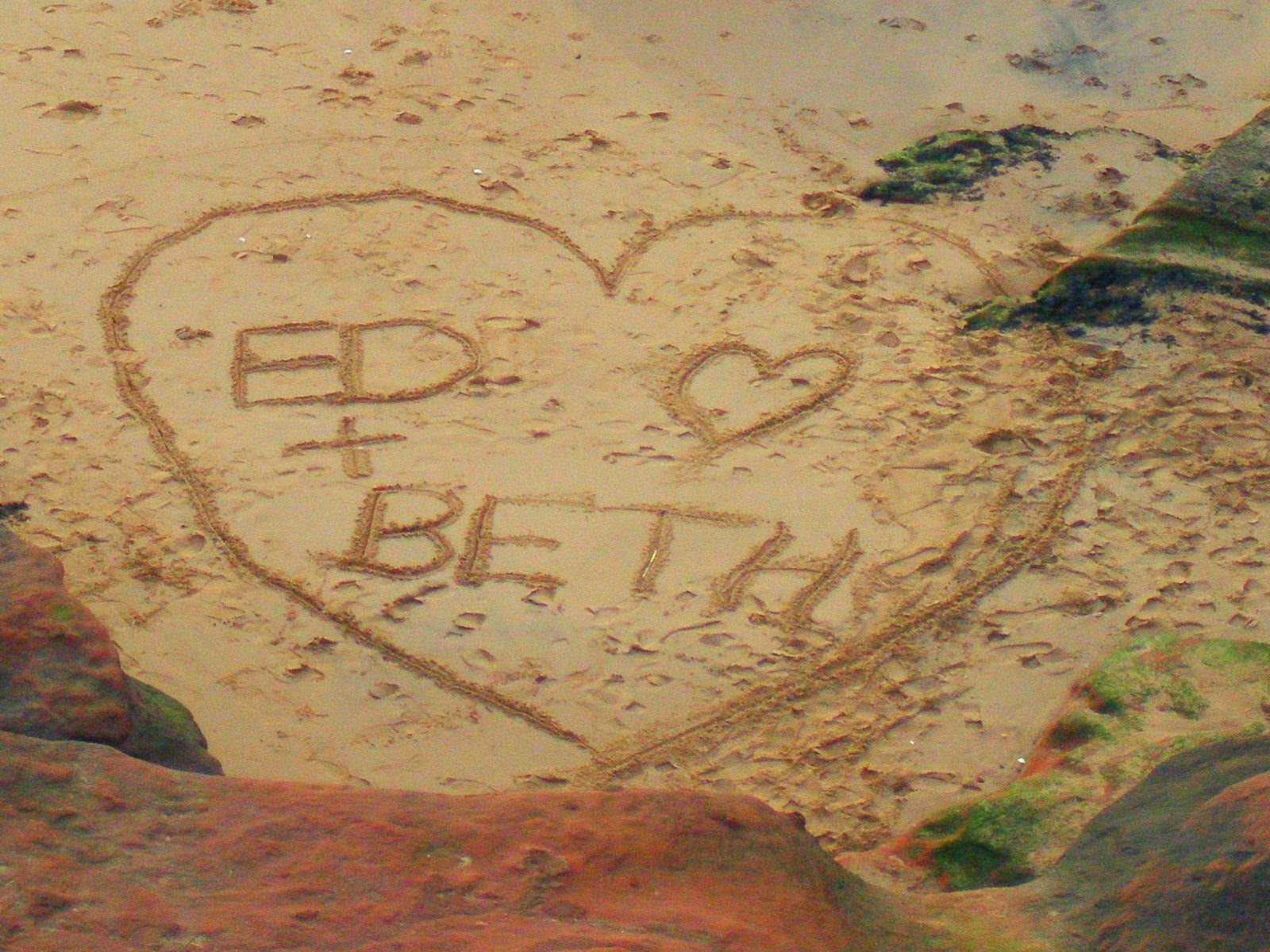
On my latest excursion as I peered down into the abyss I saw drawn
upon the sand of the beach far below a large heart with the words 'Ed
+ Beth' inside. And I pondered upon it because I knew that come the
evening when the tide came in that declaration of love would be
washed away and be gone forever. Those grains of sand arranged to
form a symbol and two words would be dissolved and swallowed up by
the sea and nobody apart from Ed and Beth would ever know they were
once there. That is, if Ed and Beth were actually there together when
the message was drawn? If it was just one of them alone there on that
beach who had drawn it then it would of course be just them alone who
would ever know. But would that make the declaration any less valid?
Would it make it more poignant? A boy or a girl alone declaring their
unrequited love for another only for it to be washed away by the sea?
So I took a photo for posterity.
I don't know who Ed and Beth are but their declaration of love is now
on the World Wide Web for potentially all to bear witness to. I don't
imagine for one moment they will ever know it's here but then that
doesn't really matter because if nothing else it makes for a nice
picture. And that's better than nothing. And any declaration of love
in this world - if even only fleeting before being swept away - is
also better than nothing.
As is said: It's better to light a candle than to curse the darkness.
I was once upon a time a great admirer of the Sex Pistols and in
particular John Rotten. I say 'once' but I should declare that still
to this day I fully appreciate them and all that they did. To think
that John was only 19 at the time of the Pistols but how brightly he
shone then. How fierce his intelligence was and how righteous his
anger. Viewing old clips of him now on YouTube it's quite astounding
how incandescent he was, articulating what I and many, many others
were thinking and feeling.
"We ain't got no heroes." he would say "They're all
useless." And oh, how I identified with that. A slight problem
being, however, that in the process John became a sort of anti-hero
hero of mine and very slavishly would I soak up his pearls of wisdom.
Over a Pink Floyd t-shirt he had scrawled 'I hate' and I thought that
if Johnny hated Pink Floyd then they must be bad so I chose to agree
with him and chose to hate them too - without ever actually
listening to them.
It was only a couple of years later at a friend's house whilst trying
our utmost to exit planet dust via his sensimilla that my friend put
on the Wish You Were Here album and I realised how brilliant Pink
Floyd actually were.
I learned a valuable lesson that day.
And wouldn't you know, it turned out that Johnny never really hated
them himself and that he even liked Hawkwind and Alvin Stardust...
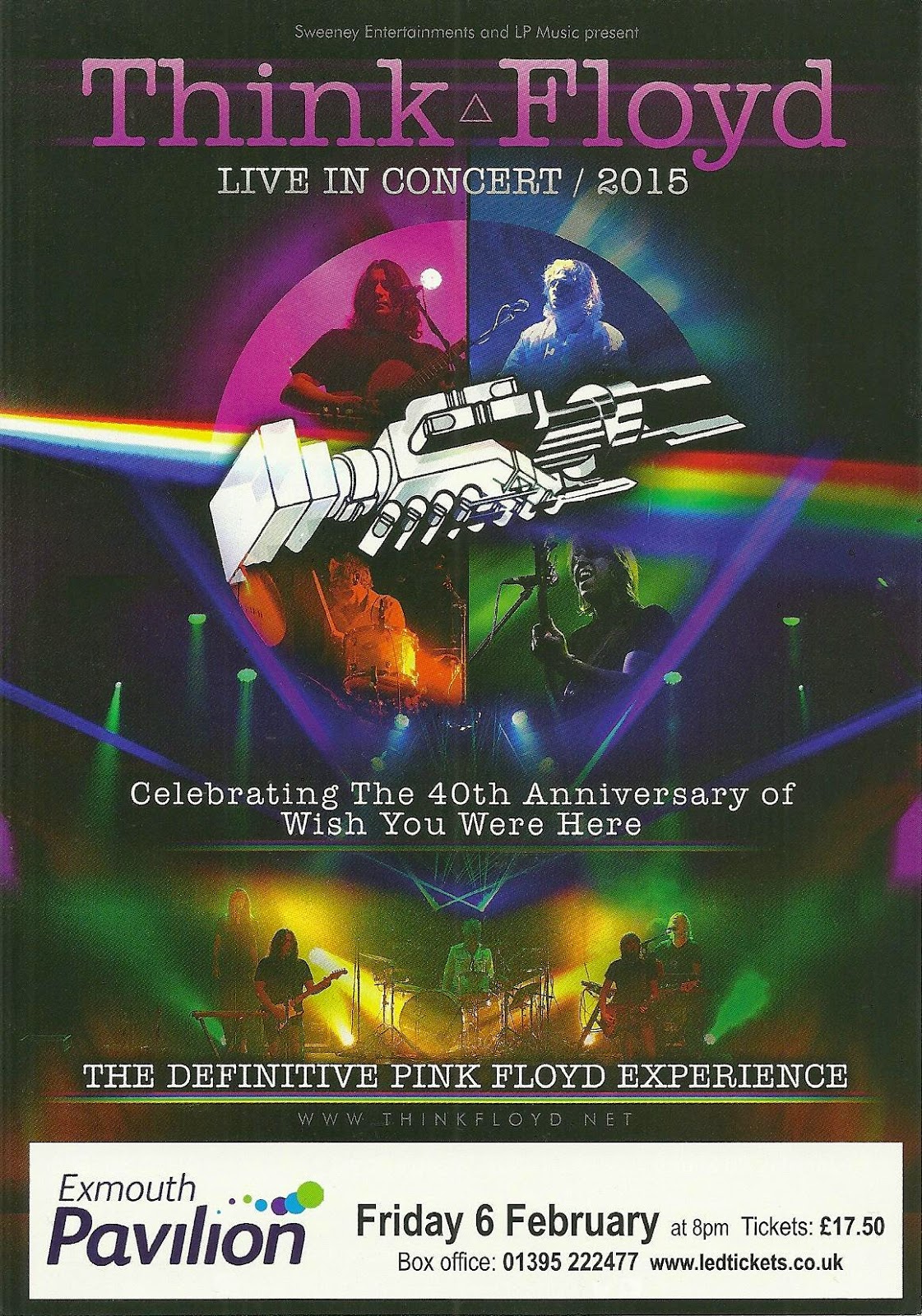
Which brings me to Think Floyd, regarded by many as being the UK's
finest tribute to Pink Floyd. They're playing at the Exmouth Pavilion
and I may just go and see them. As a teenage Anarcho Punk Rocker such
a thing would have been unthinkable, particularly as tickets are
£17.50 but you know, this is 2015. In answer to Marc Bolan's old
question, I think I know what happened to the teenage dream. I've
heard the chimes at midnight. I know for whom the bell tolls. But the
world keeps on turning. And the sun also rises.
Not that I long for the return of such days but there was a time when
you couldn't go to a gig (particularly of the Punk Rock variety)
without the night ending in an explosion of fighting on the dance
floor, or by being chased home by a pack of howling skinheads with
the scent of your blood in their nostrils.
If you care to gather round I could tell tales of Toyah screaming
hatred at brawling boneheads, of the UK Subs leaping from the stage
and swinging their mike stands wildly around at anyone and everyone
in a bid to stop mobs fighting; of the Angelic Upstarts halting play
and inviting disruptive elements up onto the stage to fight
personally with them, of the whole of Crass jumping en masse from the
stage to tackle mass punch-ups, of the Cockney Rejects punching out
shaven-headed racists only to be labelled Nazis themselves, of The
Slits heaping abuse upon fighting skinheads, of Stiff Little Fingers
buckling and fleeing from crowd violence, of Conflict pulling out
baseball bats to confront troublemakers, and so on and so on and so
on. These names won't mean much to most people nowadays but that's
fine because the point I'm making is that violence and fighting at
gigs was once endemic.
There was a time also when you couldn't go to a football match
without being caught up in or bearing witness to aggro and violence.
There was blood on the terraces and blood on the streets brought
about not only by boots and fists but coins, darts, coshes and
Stanley knives. Unlike a gig situation, the fighting was not
contained within the confines of the event but could erupt at any
point to and from the match, encroaching upon anyone who just
happened to be there at the time. At train stations and in pubs it
could be particularly ugly and many an innocent bystander could be
injured. In regards to this, however, I must admit I've never
personally ran with any football hooligan gangs but because of where
I was born and where I went to school (in Bristol, England, if
anyone's interested?), I knew plenty who did who would regularly
regale me with tales of their exploits.
So enters writer and editor of literary magazine Granta, Bill Buford,
who whilst waiting to catch a train in Cardiff one Saturday evening
encounters hundreds of Liverpool supporters packed tightly into a
train bound for London. He has to get on the same train and during
the journey witnesses destruction, wanton vandalism, aggressiveness,
theft and constant chanting. The supporters are apparently
ungovernable and unstoppable. All the police can do is to escort and
contain them until their final destination at Paddington Station.
Buford can't quite believe what he's witnessed. He's an American and
though he's been living in England for some years has never seen
anything like it before. Like Butch Cassidy to the Sundance Kid
regarding the posse in pursuit of them he asks "Who are those
guys?" but his Cambridge and Oxford-educated friends can't
really explain so he sets off to discover for himself by attending
football matches; his aim being to meet a few of these 'football
thugs', get to know them and then write about them.
In Manchester he comes upon a suitable specimen and duly introduces
himself by saying he's writing about football supporters and can he
ask a few questions? The specimen responds by stating "All
Americans are wankers and all journalists are cunts" and from
there establishes a rapport. Buford's advised to go to Turin for the
Man Utd/Juventus Cup-Winners Cup second leg match and it's there that
he starts running with the pack and dishing up vicarious thrills for
the middle class, all neatly recorded in his book Among The Thugs.
And as evidenced by the plaudits on the back cover of the book it's a
right bunch of vicarious thrill seekers he appeals to: Martin Amis,
Jonathan Raban, John Stalker at the Sunday Times, Michael Crick at
the Independent, writer John Gregory Dunne, unnamed writers at the
Daily Telegraph, the Guardian, Time Out, The Economist... All
highly-educated and cultured fellows to a man.
To be fair to Buford, his writing is actually really good and in
describing the destruction wrought upon Turin by the English football
fans he captures a series of snapshots that ring very true. As I
said, I've never ran with any football hooligan gangs but I must
admit I've been in a fair few riot situations of a more political
nature over the years and the sounds heard, the scenes witnessed and
the feelings felt are as he describes. Buford's good at writing riot
porn. He's a riot pornographer appealing to the fetishistic desires
of Martin Amis and his like.
Buford starts off by being quite witty in his descriptions of the
characters he's meeting; mocking their manners, their physiques,
their world-view - their whole lives, really. As the book progresses,
however, he gets more and more serious until it eventually starts
reading like a thesis on the nature of crowd behaviour, culminating
in an analysis of what it's like being truncheoned by a couple of
Italian riot police.
His lack of political awareness is exposed early on when he reflects
on the values of the football hooligan community and composes a list
of what they like: Lager, The Queen, the Falkland Islands, Margaret
Thatcher, Rolex watches, war movies, the Catholic Church, expensive
jumpers, lots of money, and themselves. What he doesn't seem to
realise is that what he's described is the model Tory citizen.
Thatcher's children. Thatcher's electorate holding Thatcher's values.
He then gives his game away at the end of the chapter detailing his
adventure in Turin when he describes his return to London and his
rush to get back to his home. There's an old couple having trouble
negotiating the stairs at the Marble Arch Underground station, and
they're taking one step at a time. Buford shoves them forcefully
aside so he can get past then turns around to them and says "Fuck
off. Fuck off, you old cunts." Presumably he writes of this
incident so as to show how being involved with a hooligan riot can
affect a person - even someone as well-educated and cultured as him -
and cause them to act uncivilised too. Hooliganism can be infectious,
he seems to be saying. The problem here, however, is that Buford
releases the hooliganism he's been contaminated with upon a couple of
weak, defenceless, old-aged pensioners which is actually the lowest
of the low. He's not out in a mob caught up in the madness of the
moment. He has no excuse and for all the mocking of the football
hooligans over the previous pages, it's highly unlikely that very
many of them would do as what he's just done. In fact, many would
probably have asked if the old couple needed a hand down the stairs.
He seems to think it's normal that a mob mentality in a riot
situation is simply replicated when trying to pass a couple of old
people on a flight of stairs but he's so incredibly, utterly wrong.
Following his trip to Turin he returns to the UK and continues to
attend football matches, heading up to Manchester for a Man Utd vs
West Ham game. Whilst anticipating a bloodbath, what he actually
witnesses is the humiliation of the Man Utd hooligan firms by the
infamous West Ham Inter City Firm, led by the legendary Bill
Gardiner. Buford describes Gardiner's entrance as "majestic",
standing there unflinching, flanked by his troops. This is hardcore
football hooliganism being handed to him on a plate but rather than
following the real story and trying to gain the acquaintance of
Gardiner, Buford instead heads next to a National Front disco in Bury
St Edmunds of all places. As if the NF are ruling the roost and have
unbridled influence over football crowds, and that it's here that
he'll find the answers he's searching for. He finds none, of course.
From there, over the course of the book Buford writes about the
conditions of the terraces, the physicality of being in a crowd, the
release of jubilation at a goal being scored, crowd psychology, mob
anonymity, mob violence, organised violence, the euphoria of crowd
violence, mindless violence, the ubiquity of football violence, lad
culture, Heysel Stadium, and then Hillsborough.
A lot of this is actually very intelligent writing and a lot of ideas
and insights are thrown up though at the same time there are a lot of
very deep flaws that rise up to expose Buford's ignorance, naivety
and total lack of consciousness - socially, politically and
culturally. This then calls into question the judgement of all the
critics such as Martin Amis, John Stalker, Michael Crick etc whose
praise for Buford's book has been used as blurbs on the back cover.
Just who are these people and how do they continue getting away with
being taken seriously as aficionados of literacy criticism? Are they
really up to the job? Who exactly are they talking to? Who exactly
takes their views seriously?
One of the biggest clangers Buford makes is when he states that the
working class doesn't exist any more and that there is only at best a
working class 'style': "Nothing substantive is there; there
is nothing to belong to, although it is still possible, I suppose, to
belong to a phrase - the working class - a piece of language that
serves to reinforce certain social customs and a way of talking."
If this is the case then who exactly does he think he's been talking
to out on the terraces and at his National Front discos? Who are all
these people out on the council estates, the urban sprawls, towns,
cities and villages through the UK? They may no longer be working out
on the coal fields, the docks or in heavy industry but who are then
all these people working in the call centres and the service
industries? Who are all my friends? Who are all my family? Just who
the fuck am I? Am I also simply part of a "highly mannered
suburban society stripped of culture and sophistication and living
only for its affections: a bloated code of maleness, an exaggerated
embarrassing patriotism, a violent nationalism, an array of bankrupt
antisocial habits"?
If the working class doesn't exist any more does this mean the middle
class no longer exist also? That there's no longer any upper middle
or ruling class? Is it meaningless that David Cameron and most of the
leading elite in politics, the media, business, Law, etc all come
from Eton, Oxbridge and Cambridge? Is it just some fucking
coincidence?
Among The Thugs isn't a bad book at all, in fact a lot of it
is very interesting and it's very well written but what it brings to
mind whilst reading it are the lines from the song Common People by
Pulp:
"Like a dog lying in a corner, they'll bite you and never
warn you. Look out! They'll tear your insides out.
Cos everybody hates a tourist, especially one who thinks it's all
such a laugh, and the chip stains and grease will come out in the
bath.
You'll never understand how it feels to live your life with no
meaning or control and with nowhere left to go.
You're amazed that they exist and they burn so bright while you
can only wonder why."
Bill Buford is a tourist and so too is Martin Amis and all the many
other critics who have praised this book to the skies. Every single
one of them fails to understand the subject matter in hand whether
they’re writing about it like Buford or simply reading about it
like Amis et al. And they would probably all scoff at, guffaw or
vehemently deny the very idea but the lives they lead are much less
interesting than those they choose to write about, deride and read
about.
Their antics may not be to everyone’s taste but ultra hooligans
such as Bill Gardiner and all the other working class people whose
existences are denied do indeed burn brightly as the Pulp song
suggests whilst Buford and Amis et al remain as nothing but damp
squibs; collectively and individually wondering why whilst
congratulating themselves for their devastating literacy skills,
their sizzling repartee, their considered opinions and breathtaking
insights in one very small, self-centred and exclusive mutual
masturbation club.
Among the thugs? There are football thugs but there are also
intellectual thugs of a more academic nature being paid good money to
expound, pontificate and elucidate upon subjects they blatantly have
very little understanding of. Laying down their social and cultural
guidelines within very restricted parameters. And of which is the
most powerful and of which is the most dangerous depends entirely
upon where you're from and where you're at.