Showing posts with label Jean Cocteau. Show all posts

Saturday, 5 December 2015

Opium - Jean Cocteau

OPIUM - JEAN COCTEAU

Jean Cocteau's Opium is not so much an ode to the drug but a diary of his thoughts, memories and dreams during his withdrawal from his addiction to it during his stay at a French clinic. There's no explanation of how he became addicted to the pipe in the first place and no description of the cure process but instead is a record of his state of mind laid down in words and drawings.
Curiously, in many ways Cocteau's drawings convey a lot more about where his mind is at than his words but then again maybe that's understandable? Does not a picture, after all, paint a thousand words?


In saying this, however, there are three notes in the book that do stand out, the first (and one of Cocteau's most famous quotes) being:
"Everything one does in life, even love, occurs in an express train racing towards death. To smoke opium is to get out of the train while it is still moving. It is to concern oneself with something other than life or death."
The second being:
"The smoker has a bird's eye view of himself."
And the third being:
"The Normal Man: Elder pith addict, why live this existence? It would be better to throw yourself out of the window.
The Addict: Impossible. I am floating.
The Normal Man: Your body will quickly reach the bottom.
The Addict: I shall arrive slowly after it."

Listen. I'm not one to romanticise or glamorise drugs at all. I've seen the needle and the damage done. I'm not about, however, to deny their existence or become sanctimonious about drugs. I'm not a drugs zealot but neither do I run scared of them. In this world you choose your poison or if you don't then it will choose you. Jean Cocteau chose the poppy and though he became addicted he regretted it none.
Written in the 1920s, his was one of the first books (along with De Quincey's Confessions Of An English Opium Eater) to discuss opium and addiction without prejudice nor shame and in doing so, a doorway - a portal - was prised open just that little bit further allowing others to squeeze through and report on twilight worlds hitherto unexplored.

I don't believe for one moment that Jean Cocteau influenced anyone into experimenting with opium just as I don't believe the works of William Burroughs or Lou Reed led people into taking heroin. Drugs have always been with us and always will. They have always been used and will always continue to be used no matter whether they're condoned, condemned, legalised or prohibited.

Jean Cocteau's Opium (or to give it its full title, Opium - The Diary Of A Cure) isn't an essential read at all, in fact it's probably of more interest and of more relevance to his admirers than to those interested in drug culture as in it he writes more about the theatre, poetry, art and his friends (such as Eisenstein, Proust and Picasso) than he does about opium. It is, however, an important book if only for the fact that it was written by an important artist who these days appears to have slipped from people's consciousness. Apart, that is, from in Exmouth where a Jean Cocteau revival is spluttering into life...
John Serpico
Jean genie

Tuesday, 27 October 2015

The Impostor - Jean Cocteau

THE IMPOSTOR - JEAN COCTEAU

I was unaware of Jean Cocteau's sense of humour until reading his novel, The Impostor. Why did I presume he was a serious-minded fellow interested only in serious art and serious subjects albeit revolving around the avant garde? His humour might be black but here it is on display for all to see if anyone cares to look.
It's rather similar to the way Morrissey is viewed as a miserable person when in actual fact he's a very funny guy. The same with Hilary Mantel as in her being viewed strictly as a serious writer when in actual fact she possesses a very keen sense of humour.


The Impostor concerns itself with the collision between the reality of war and the fantasia of the mind. It's set in France during the First World War at the point where the government has fled Paris and all kinds of madness is subsequently flourishing. Those who have chosen to stay behind are either heroic, loyal, foolish or just plain crazy; and in many cases a good mixture of all four of these things.
Cocteau introduces us to an esoteric troupe of misfits gathered together under the leadership of a princess who has ambitions to be a cross between a Florence Nightingale figure and an actress. She's set up base at an old nursing home in Paris and is setting off for the front line in a convoy of vehicles carrying crates of dry biscuits, oranges and Cordial-Medoc. Their mission being to pick up wounded soldiers and bring them back to Paris.

Just before they're due to depart a sixteen year-old boy in a soldier's uniform enters the camp and on being asked his name is mistaken for the nephew of a famous and much revered General. He does nothing to correct the mistake and in fact assures everyone that he is indeed the General's nephew. The boy is, however, nothing more than a wandering fantasist who has spent his whole life in a world of make-believe and delusion. His fantasies and his adoption of another's identity serve to be a useful asset to the princess who asks him to help her secure the necessary passes and documents required to travel unobstructed through France. He duly sources her the papers that she needs simply by mentioning to the authorities the 'fact' that he's the General's nephew.

Cocteau describes the war as a Catch 22/MASH-type situation of blackly funny and illogical circumstances. He wrote it, however, in 1923 so this is years before either of those books (or films) had even been thought of.
At times it's not the most well written book ever but this might perhaps be down to the translation? It's Cocteau's weaving of reality, fantasy and farce that makes it interesting, particularly in his depiction of the young boy living a life of illusion ultimately to the benefit of other people. The boy himself is unable to distinguish between reality and falsehood but nor does he make any attempt to do so.
His fantasy is his reality, right up to the final moment on the battlefield at the end of the book where he is shot and says to himself he doesn't have a chance unless he pretends to be dead - even though he is actually dead already.

Cocteau would go on to develop his ideas and his writing powers most notably in Les Enfants Terribles before moving into film making. Though having written much poetry before, it was with The Impostor where it all really began and if for no other reason this makes it an important book. Perhaps significantly, the same year that The Impostor was first published Cocteau became addicted to opium...
John Serpico

Friday, 10 April 2015

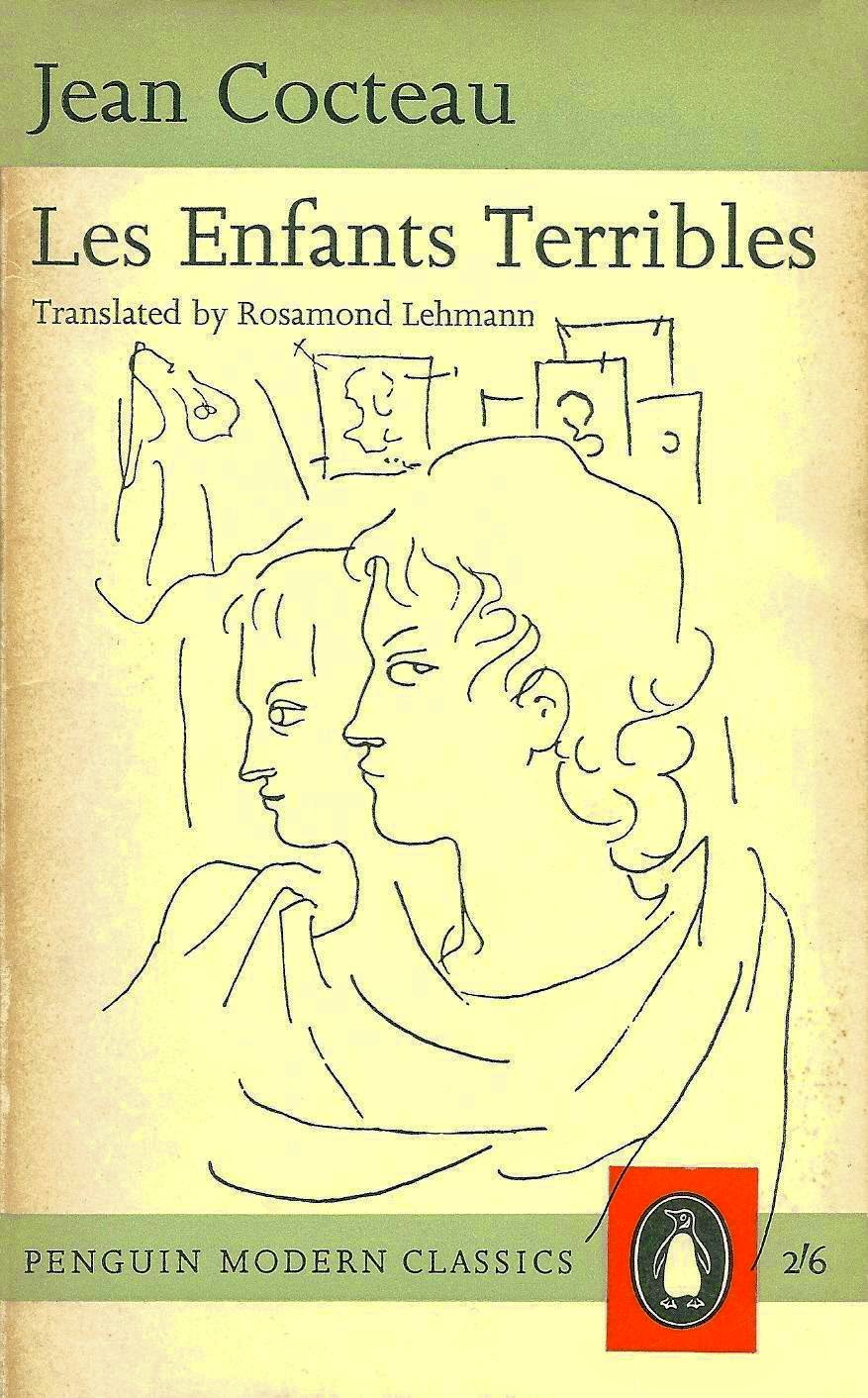
Les Enfants Terribles - Jean Cocteau

LES ENFANTS TERRIBLES - JEAN COCTEAU

I know he's not in the Best Sellers lists but does anybody read Jean Cocteau nowadays? And if not - why not? And indeed, if not - why should they?
I must admit I don't actually know that much about Jean Cocteau as a person, all I know is his work which perhaps is the way it should be? He was a poet, essentially, and he regarded all of his work as an extension of his poetry in different media be it in film, theatre, verse, criticism, or novel. I must also admit I didn't really understand what his novel Les Enfants Terribles was about until I was over half-way through it but so beautifully is it written that it didn't really matter.


So what is Les Enfants Terribles about? I might be wrong but it's about a brother and sister going from childhood to young adulthood in a private, perpetual state of near-hysteria. It's about the unbalanced and unsettling relationship between them as they suck other people into their 'game' causing lives to spin out of control yet be caught in an orbit of exact logic.
Their lives have been affected and are dictated by events not of their own making such as having had an unstable father who is now dead and an equally unstable mother who dies quite early on in the story. The brother and sister are subsequently left to their own devices to create their own world full of secrets, exaggerations and petulance. All children are capable of transporting themselves to another world of make-believe where if there are any rules at all then they are rules that only make sense to the child. The brother and sister live in such a world for rather than having left that world behind along with childish habits they've carried it on into their teenage and young adult years. Their obsessions, their squabbles, their antics, their spitefulness - all are of the stuff of children.
A hint as to what is to come is given soon after the main characters have been introduced when a friend spots some words printed in soap upon a mirror in the brother and sister's house declaring 'Suicide is a mortal sin'. There's no explanation for the words being written on the mirror and in fact they're taken as just another oddity to add to the general oddness of their lives.

A snowball with a rock hidden inside is thrown at the brother at the start of the story and it's this event that sets off a whole chain of events. The snowball has been thrown by a boy whom the brother obsesses over and he falls ill from being struck by it. Some years later a friend of his sister comes to live with them and the brother is struck by her resemblance to the snowball thrower. The brother comes to see that he's in love with her but having never really grown up he's unable to express such emotions particularly with the added problem of his sister's jealousy. After much manipulation by the sister everyone ends up in miserable states of affairs. The spectre of the snowball thrower enters their world again when he is encountered by a mutual friend and as a gift to the brother he passes on some poison to him. It's not stated but the poison may well be opium?

Reading Les Enfants Terribles is like looking into a smashed mirror and trying to see the face peering back. Details can be seen clearly in many of the shards but the whole is partially obscured due to the cracks. You know a face is there but it's hard to define.

Jean Cocteau was a famous imbiber of opium and if you know anything about opium (as we all do down here in Exmouth) then it helps to understand where the book is coming from. Not that you need to be a drug fiend or anything of the like to enjoy it. Les Enfants Terribles, I should declare, is a work of art and even though it was written in 1929 it hasn't aged in the slightest. It sits, in fact, in an almost eminent place of its own and towers over much more widely read and feted literature. Jean Cocteau isn't in the Best Sellers lists but he should be far better known than what he is.

And so too, come to think of it, should the Cocteau Twins....
John Serpico