I was once upon a time a great admirer of the Sex Pistols and in
particular John Rotten. I say 'once' but I should declare that still
to this day I fully appreciate them and all that they did. To think
that John was only 19 at the time of the Pistols but how brightly he
shone then. How fierce his intelligence was and how righteous his
anger. Viewing old clips of him now on YouTube it's quite astounding
how incandescent he was, articulating what I and many, many others
were thinking and feeling.
"We ain't got no heroes." he would say "They're all
useless." And oh, how I identified with that. A slight problem
being, however, that in the process John became a sort of anti-hero
hero of mine and very slavishly would I soak up his pearls of wisdom.
Over a Pink Floyd t-shirt he had scrawled 'I hate' and I thought that
if Johnny hated Pink Floyd then they must be bad so I chose to agree
with him and chose to hate them too - without ever actually
listening to them.
It was only a couple of years later at a friend's house whilst trying
our utmost to exit planet dust via his sensimilla that my friend put
on the Wish You Were Here album and I realised how brilliant Pink
Floyd actually were.
I learned a valuable lesson that day.
And wouldn't you know, it turned out that Johnny never really hated
them himself and that he even liked Hawkwind and Alvin Stardust...
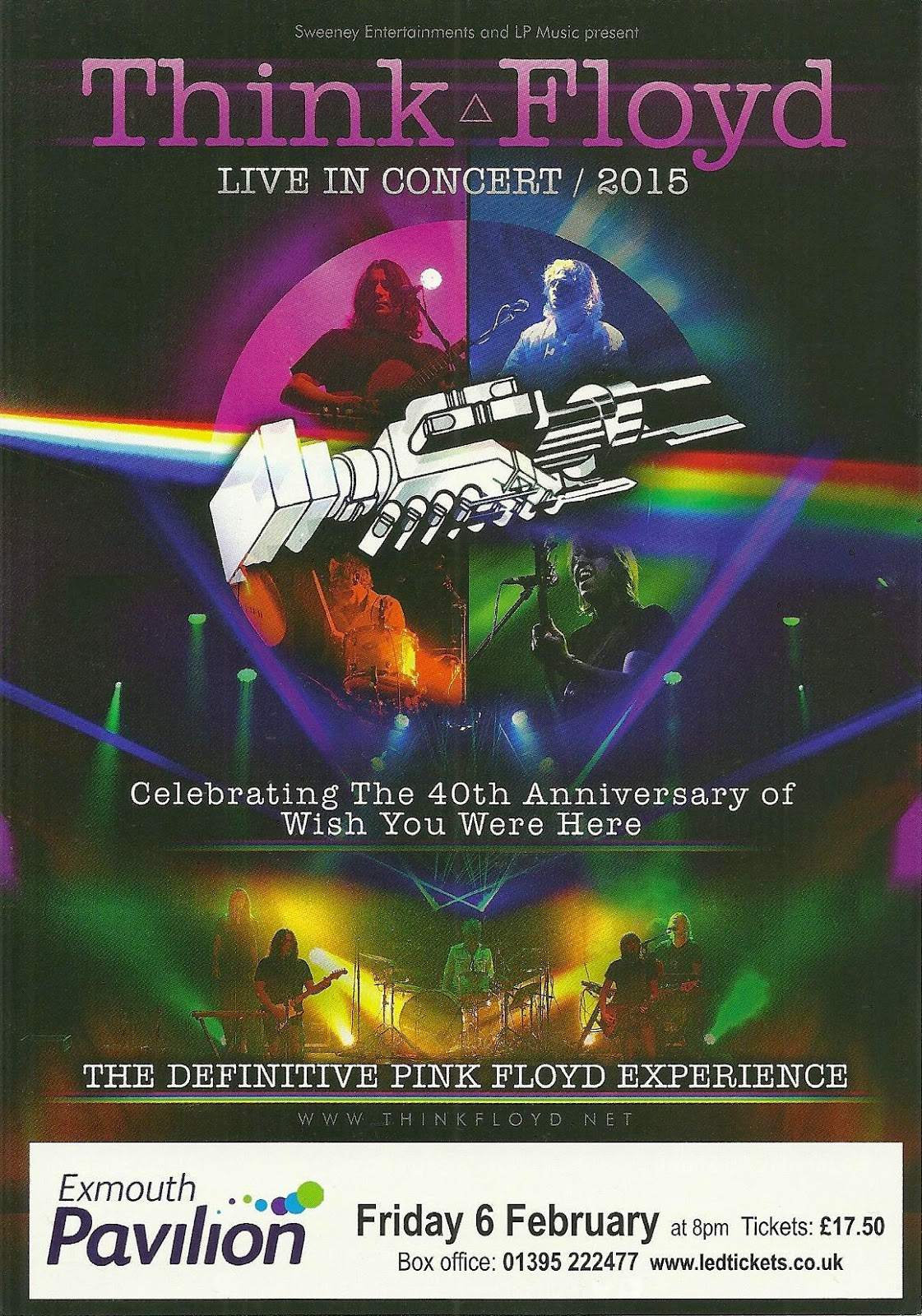
Which brings me to Think Floyd, regarded by many as being the UK's
finest tribute to Pink Floyd. They're playing at the Exmouth Pavilion
and I may just go and see them. As a teenage Anarcho Punk Rocker such
a thing would have been unthinkable, particularly as tickets are
£17.50 but you know, this is 2015. In answer to Marc Bolan's old
question, I think I know what happened to the teenage dream. I've
heard the chimes at midnight. I know for whom the bell tolls. But the
world keeps on turning. And the sun also rises.
Not that I long for the return of such days but there was a time when
you couldn't go to a gig (particularly of the Punk Rock variety)
without the night ending in an explosion of fighting on the dance
floor, or by being chased home by a pack of howling skinheads with
the scent of your blood in their nostrils.
If you care to gather round I could tell tales of Toyah screaming
hatred at brawling boneheads, of the UK Subs leaping from the stage
and swinging their mike stands wildly around at anyone and everyone
in a bid to stop mobs fighting; of the Angelic Upstarts halting play
and inviting disruptive elements up onto the stage to fight
personally with them, of the whole of Crass jumping en masse from the
stage to tackle mass punch-ups, of the Cockney Rejects punching out
shaven-headed racists only to be labelled Nazis themselves, of The
Slits heaping abuse upon fighting skinheads, of Stiff Little Fingers
buckling and fleeing from crowd violence, of Conflict pulling out
baseball bats to confront troublemakers, and so on and so on and so
on. These names won't mean much to most people nowadays but that's
fine because the point I'm making is that violence and fighting at
gigs was once endemic.
There was a time also when you couldn't go to a football match
without being caught up in or bearing witness to aggro and violence.
There was blood on the terraces and blood on the streets brought
about not only by boots and fists but coins, darts, coshes and
Stanley knives. Unlike a gig situation, the fighting was not
contained within the confines of the event but could erupt at any
point to and from the match, encroaching upon anyone who just
happened to be there at the time. At train stations and in pubs it
could be particularly ugly and many an innocent bystander could be
injured. In regards to this, however, I must admit I've never
personally ran with any football hooligan gangs but because of where
I was born and where I went to school (in Bristol, England, if
anyone's interested?), I knew plenty who did who would regularly
regale me with tales of their exploits.
So enters writer and editor of literary magazine Granta, Bill Buford,
who whilst waiting to catch a train in Cardiff one Saturday evening
encounters hundreds of Liverpool supporters packed tightly into a
train bound for London. He has to get on the same train and during
the journey witnesses destruction, wanton vandalism, aggressiveness,
theft and constant chanting. The supporters are apparently
ungovernable and unstoppable. All the police can do is to escort and
contain them until their final destination at Paddington Station.
Buford can't quite believe what he's witnessed. He's an American and
though he's been living in England for some years has never seen
anything like it before. Like Butch Cassidy to the Sundance Kid
regarding the posse in pursuit of them he asks "Who are those
guys?" but his Cambridge and Oxford-educated friends can't
really explain so he sets off to discover for himself by attending
football matches; his aim being to meet a few of these 'football
thugs', get to know them and then write about them.
In Manchester he comes upon a suitable specimen and duly introduces
himself by saying he's writing about football supporters and can he
ask a few questions? The specimen responds by stating "All
Americans are wankers and all journalists are cunts" and from
there establishes a rapport. Buford's advised to go to Turin for the
Man Utd/Juventus Cup-Winners Cup second leg match and it's there that
he starts running with the pack and dishing up vicarious thrills for
the middle class, all neatly recorded in his book Among The Thugs.
And as evidenced by the plaudits on the back cover of the book it's a
right bunch of vicarious thrill seekers he appeals to: Martin Amis,
Jonathan Raban, John Stalker at the Sunday Times, Michael Crick at
the Independent, writer John Gregory Dunne, unnamed writers at the
Daily Telegraph, the Guardian, Time Out, The Economist... All
highly-educated and cultured fellows to a man.
To be fair to Buford, his writing is actually really good and in
describing the destruction wrought upon Turin by the English football
fans he captures a series of snapshots that ring very true. As I
said, I've never ran with any football hooligan gangs but I must
admit I've been in a fair few riot situations of a more political
nature over the years and the sounds heard, the scenes witnessed and
the feelings felt are as he describes. Buford's good at writing riot
porn. He's a riot pornographer appealing to the fetishistic desires
of Martin Amis and his like.
Buford starts off by being quite witty in his descriptions of the
characters he's meeting; mocking their manners, their physiques,
their world-view - their whole lives, really. As the book progresses,
however, he gets more and more serious until it eventually starts
reading like a thesis on the nature of crowd behaviour, culminating
in an analysis of what it's like being truncheoned by a couple of
Italian riot police.
His lack of political awareness is exposed early on when he reflects
on the values of the football hooligan community and composes a list
of what they like: Lager, The Queen, the Falkland Islands, Margaret
Thatcher, Rolex watches, war movies, the Catholic Church, expensive
jumpers, lots of money, and themselves. What he doesn't seem to
realise is that what he's described is the model Tory citizen.
Thatcher's children. Thatcher's electorate holding Thatcher's values.
He then gives his game away at the end of the chapter detailing his
adventure in Turin when he describes his return to London and his
rush to get back to his home. There's an old couple having trouble
negotiating the stairs at the Marble Arch Underground station, and
they're taking one step at a time. Buford shoves them forcefully
aside so he can get past then turns around to them and says "Fuck
off. Fuck off, you old cunts." Presumably he writes of this
incident so as to show how being involved with a hooligan riot can
affect a person - even someone as well-educated and cultured as him -
and cause them to act uncivilised too. Hooliganism can be infectious,
he seems to be saying. The problem here, however, is that Buford
releases the hooliganism he's been contaminated with upon a couple of
weak, defenceless, old-aged pensioners which is actually the lowest
of the low. He's not out in a mob caught up in the madness of the
moment. He has no excuse and for all the mocking of the football
hooligans over the previous pages, it's highly unlikely that very
many of them would do as what he's just done. In fact, many would
probably have asked if the old couple needed a hand down the stairs.
He seems to think it's normal that a mob mentality in a riot
situation is simply replicated when trying to pass a couple of old
people on a flight of stairs but he's so incredibly, utterly wrong.
Following his trip to Turin he returns to the UK and continues to
attend football matches, heading up to Manchester for a Man Utd vs
West Ham game. Whilst anticipating a bloodbath, what he actually
witnesses is the humiliation of the Man Utd hooligan firms by the
infamous West Ham Inter City Firm, led by the legendary Bill
Gardiner. Buford describes Gardiner's entrance as "majestic",
standing there unflinching, flanked by his troops. This is hardcore
football hooliganism being handed to him on a plate but rather than
following the real story and trying to gain the acquaintance of
Gardiner, Buford instead heads next to a National Front disco in Bury
St Edmunds of all places. As if the NF are ruling the roost and have
unbridled influence over football crowds, and that it's here that
he'll find the answers he's searching for. He finds none, of course.
From there, over the course of the book Buford writes about the
conditions of the terraces, the physicality of being in a crowd, the
release of jubilation at a goal being scored, crowd psychology, mob
anonymity, mob violence, organised violence, the euphoria of crowd
violence, mindless violence, the ubiquity of football violence, lad
culture, Heysel Stadium, and then Hillsborough.
A lot of this is actually very intelligent writing and a lot of ideas
and insights are thrown up though at the same time there are a lot of
very deep flaws that rise up to expose Buford's ignorance, naivety
and total lack of consciousness - socially, politically and
culturally. This then calls into question the judgement of all the
critics such as Martin Amis, John Stalker, Michael Crick etc whose
praise for Buford's book has been used as blurbs on the back cover.
Just who are these people and how do they continue getting away with
being taken seriously as aficionados of literacy criticism? Are they
really up to the job? Who exactly are they talking to? Who exactly
takes their views seriously?
One of the biggest clangers Buford makes is when he states that the
working class doesn't exist any more and that there is only at best a
working class 'style': "Nothing substantive is there; there
is nothing to belong to, although it is still possible, I suppose, to
belong to a phrase - the working class - a piece of language that
serves to reinforce certain social customs and a way of talking."
If this is the case then who exactly does he think he's been talking
to out on the terraces and at his National Front discos? Who are all
these people out on the council estates, the urban sprawls, towns,
cities and villages through the UK? They may no longer be working out
on the coal fields, the docks or in heavy industry but who are then
all these people working in the call centres and the service
industries? Who are all my friends? Who are all my family? Just who
the fuck am I? Am I also simply part of a "highly mannered
suburban society stripped of culture and sophistication and living
only for its affections: a bloated code of maleness, an exaggerated
embarrassing patriotism, a violent nationalism, an array of bankrupt
antisocial habits"?
If the working class doesn't exist any more does this mean the middle
class no longer exist also? That there's no longer any upper middle
or ruling class? Is it meaningless that David Cameron and most of the
leading elite in politics, the media, business, Law, etc all come
from Eton, Oxbridge and Cambridge? Is it just some fucking
coincidence?
Among The Thugs isn't a bad book at all, in fact a lot of it
is very interesting and it's very well written but what it brings to
mind whilst reading it are the lines from the song Common People by
Pulp:
"Like a dog lying in a corner, they'll bite you and never
warn you. Look out! They'll tear your insides out.
Cos everybody hates a tourist, especially one who thinks it's all
such a laugh, and the chip stains and grease will come out in the
bath.
You'll never understand how it feels to live your life with no
meaning or control and with nowhere left to go.
You're amazed that they exist and they burn so bright while you
can only wonder why."
Bill Buford is a tourist and so too is Martin Amis and all the many
other critics who have praised this book to the skies. Every single
one of them fails to understand the subject matter in hand whether
they’re writing about it like Buford or simply reading about it
like Amis et al. And they would probably all scoff at, guffaw or
vehemently deny the very idea but the lives they lead are much less
interesting than those they choose to write about, deride and read
about.
Their antics may not be to everyone’s taste but ultra hooligans
such as Bill Gardiner and all the other working class people whose
existences are denied do indeed burn brightly as the Pulp song
suggests whilst Buford and Amis et al remain as nothing but damp
squibs; collectively and individually wondering why whilst
congratulating themselves for their devastating literacy skills,
their sizzling repartee, their considered opinions and breathtaking
insights in one very small, self-centred and exclusive mutual
masturbation club.
Among the thugs? There are football thugs but there are also
intellectual thugs of a more academic nature being paid good money to
expound, pontificate and elucidate upon subjects they blatantly have
very little understanding of. Laying down their social and cultural
guidelines within very restricted parameters. And of which is the
most powerful and of which is the most dangerous depends entirely
upon where you're from and where you're at.
I've always had a fondness for bees and always pay them much respect.
So, much respect to the tea rooms in Manor Gardens, Exmouth, for not
only calling themselves Bumble and Bee but for having a very large
stencil of a bee on the outside wall of the building.
As Kate Bush
once said in an interview with the NME many years ago: "Fancy being a bee, leading an incredible existence. All these flowers designed just for you. Flying into the runway,
incredible colours. Some trip...."
They call them 'ghost signs'. Old, hand-painted murals on gable ends
advertising products and businesses from a by-gone age. And it's an
apt name to give them as they are indeed like ghosts from the past
offering somewhat haunted glimpses into history.
They can be found on buildings in towns throughout Britain, and
Exmouth is no exception. In fact, Exmouth can boast one of the most
beautiful examples on a derelict, boarded-up building near to the
centre of town. Yes, there really are boarded-up, derelict buildings
in Exmouth and it's all the better here for them.
The ghost sign in question is a mural advertising a long-gone photo
studio by the name of Memory Makers. I know nothing more about it
than that. Which is rather fitting and also rather poignant.
Memory
Makers: a place where memories were once saved but now itself fading
from memory...
When first published in 1974, James Herbert's debut novel The Rats
was like a firecracker being set off in a church. His writing was
in a direct, no-holds-barred, straight-for-the-jugular style that
left all other writers working in the same genre standing at the
touch-line. Critics were apparently dismayed at the explicit horror
he portrayed and were subsequently dismissive of him but for the
thousands of readers who never read book reviews and never considered
the opinions of Martin Amis and such like, James Herbert and his book
The Rats was exactly what they wanted.
The Rats is a straightforward horror story about a new breed of
vicious super rats the size of dogs, erupting from the slum houses
and bomb-sites of London's East End and bringing terror to the people
there. It's a relatively simple idea for a story, of course, but it's
the manner in which Herbert wrote it that makes it so outstanding.
Each character is given a potted history, explaining who they are and
how they've ended up in the job or life position they're now in.
They're all then horribly slaughtered by the rats. Scenarios are set
up whereupon the arrival of the rats cause maximum carnage and
mayhem. So for example, Herbert has them attack a tube train stuck in
a tunnel, a cinema audience, all the animals at a zoo, and a school
full of children.
Herbert exploits to the hilt the inherent dislike if not fear of rats
in most people and imagines all the places where an attack by hordes
of them would be most dreaded; so it's in darkened places such as
down in a tube station or in a cinema, or when in the daylight it's
against the most vulnerable such as children and animals.
Herbert paints a vivid picture of a neglected London where tramps
gather on wastelands at night, where children are tough but their
environment tougher, and where the working class eke out their lives
under the governance of incompetent authorities. As a depiction of
early 1970s Britain it's a very accurate one, a depiction that at the
time was hardly ever represented in the media. Re-reading The Rats
today, it's apparent that Herbert was pre-empting the Sex Pistols and
Punk Rock by almost three years. His London is one of no future and
his rats are Year Zero made flesh. His was the modern world. The Rats
was Punk Rock in book form, acting like a brick through a window.
Pre-Punk Rock the music industry was dominated by lumbering dinosaurs
such as Genesis, Pink Floyd, ELP and so on until the Sex Pistols and
their bastard children scared and chased them all away with a dollop
of urban realism on the end of a broken stick. In a similar fashion,
James Herbert and his Rats book did exactly the same but to the likes
of Dennis Wheatley and H P Lovecraft - the supposed establishment
figures of horror writing. Spread by word of mouth, The Rats was
picked up by a whole new generation of readers, propelling itself
away from the typical type of books aimed at teenagers and out to the
council estates and inner cities where copies would be passed around.
Punk Rock corrupted and ruined many a teenager's life for the better
and so too did The Rats. James Herbert captured both the dreams and
the nightmares of children and thrust them screaming into the
present. The dreams and nightmares of those children were never the
same again.
"We are The Fall." as Mark E Smith declared on the
debut album 'Live At The Witch Trials' back in 1978 "Northern
white crap that talks back." And almost 40 years later, on
stepping onto the stage at any Fall gig Mark still introduces the
band by declaring "We are The Fall" even if it's
just him and his granny on bongos. It's a pertinent point for amongst
other things The Fall are famous for having a bewilderingly high
number of line-up changes over the years and it's this that
journalist Dave Simpson has chosen to write a book about, naming it -
naturally - The Fallen.
In excess of forty musicians have passed through the ranks of The
Fall in almost as many years and Simpson makes it his mission to
track down each and every one of them though his reason for doing so
is never really made clear. He's a Fall fan, of course, or perhaps
that should be a 'Fall obsessive' and it seems to him to be a
perfectly reasonable thing to do.
"Ha ha ha ha ha. You're crazy!" says former lead
guitarist Marc Riley who along with all other ex-members that Simpson
approaches, still agrees to be interviewed. For Simpson, he imagines
the former members might hold the key to the legends of The Fall and
that they're a piece of social history, as in decades of music seen
through the eyes of the foot soldiers. Mark E Smith, however, fails
to understand and finds it all very boring: "I don't
understand the big deal with it." he says "They
came, they saw, they fucked off and now I no longer see them. The
Fall are about the present, and that's it."
Mark also fails to understand why former members are so quick to talk
about their Fall-years (or days): "It's as if they've been to
Vietnam or had a particularly fraught space-excursion and their
senses have been obliterated. It's all they can talk about, it's all
that remains in their fried heads. I'm thinking about setting up a
post-Fall-syndrome therapy hour. That'd chase a few wolves from the
door." And as often is the case, there's a lot of truth in
what Mark says because what comes over in the interviews Simpson
conducts is that the former members are indeed in need of some form
of therapy and use their interview as a way of getting it for free.
There are certain things some of them still can't bring themselves to
talk about: dark, drug induced secrets; demons they still shy away
from addressing, though strangely they all say they'd return and play
with The Fall again if asked.
Of all the former members, the most interesting is Kay Carroll who
from 1977 to 1983 sang backing vocals but more importantly, was the
band's manager. By all accounts Carroll was (and still is) a
formidable woman who terrified her fellow band members. She was also
Mark's girlfriend at the time. According to Carroll, The Fall's
entire 'no sell-out/outsiders' stance was her creation, her 'musical
instrument'. "I brought an ideology to The Fall and Mark
carried it on." she says.
The ex-member offering the best insight into The Fall is perhaps not
by coincidence also a woman, that being Brix Smith, former
guitarist/backing vocalist/'stylist' and also Mark's wife at the time
of her being in the band. According to Brix: "Like a great
painting, what people make of The Fall is actually a reflection of
themselves." This idea is expounded upon by ex-member Marcia
Schofield who played keyboards, who suggests that The Fall are a
mirror and Mark E Smith is "a walking, cultural Rorschach
Test."
The thing about these specific offerings is that not only are they
from women but they also echo my take on Albert Camus' book The Fall
(see a previous review), from which Mark, of course, took the name
for his band. And it's funny that of all the people interviewed by
Simpson - including Carroll, Brix, and Schofield - none of them not
once mentions Camus' book or even hints that they've ever read it.
Simpson just about succeeds in his quest but apart from an article in
The Guardian and the completion of his book, in the end he actually
has very little to show for it. In fact, he seems to have lost more
than he's gained for not only has his girlfriend of 17 years left him
- tired of taking second place to his Fall obsession - but he's also
received withering condemnation from Mark E Smith himself for 'the
hatchet job on Fall members past and present'. But then what did
he expect? Particularly as at times in the book he comes across as a
stalker, even at one point lurking around outside of Mark's home and
asking neighbours if they know who lives there? And sure they do.
"Mad Mark", as one of them replies with a shrug, as if to
say 'And? So what? What's it to you? What's it to anyone?'
And so consequently, if as Brix Smith suggests The Fall simply
reflects and as Marcia Schofield suggests that The Fall is a mirror;
what we're left with at the end of the book is a not very flattering
portrait of the author Dave Simpson going through a very long and
slow nervous breakdown. The one unexpected blessing for him being
that though he's not actually become a member of The Fall, in a
certain way he has become a member of The Fallen who like the others belonging to that particular club who he's tracked down and interviewed, seems to be in need of some form of therapy.